Inside China’s booming caviar kingdom supplying the world’s Michelin restaurants and airlines
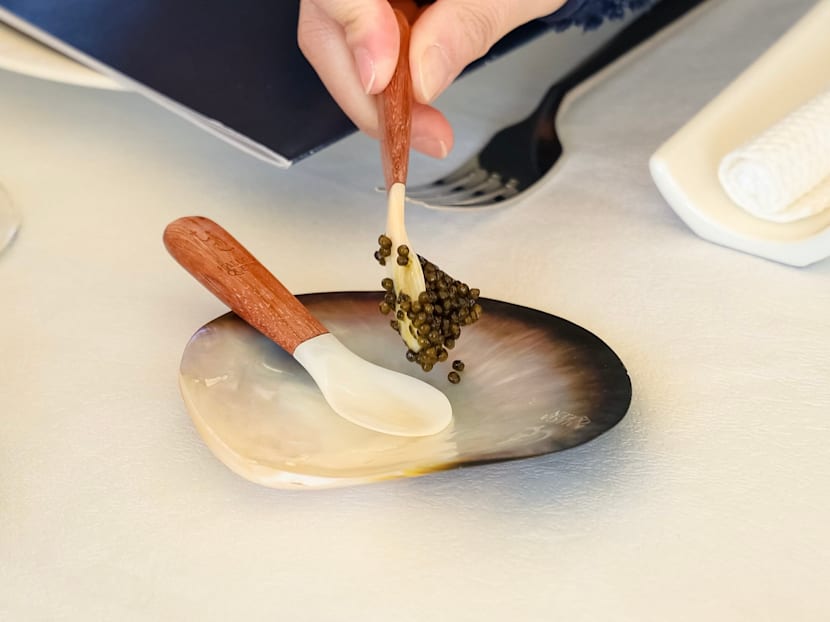
Yes, the world’s biggest producer of caviar is in China. CNA Luxury visited the pristine waters of Qiandao Lake near Hangzhou, where Chinese company Kaluga Queen raises hundreds of thousands of sturgeon and produces 260 tonnes of caviar annually. Here’s what we found within China’s high-tech luxury fish-egg empire.
(Photo: Kaluga Queen)

This audio is generated by an AI tool.


One tends to assume caviar is born in some moody corner of the Caspian Sea, tended by men with moustaches and tragic backstories. If you, too, think all of the caviar spooned onto your plate in tastefully-lit restaurants comes from somewhere in Russia, Iran, or even France or Italy, you are about a decade behind the times.
Discovering that China now leads the global caviar industry feels a bit like being told that Switzerland secretly grows all the world’s durians. But, it is increasingly common knowledge that these days, the world’s biggest stash of fish eggs is indeed farmed in the Middle Kingdom.
There are several top players in China, but the biggest one is Kaluga Queen, whose output is a staggering 260 tonnes of caviar a year, supplying over one-third of global demand.
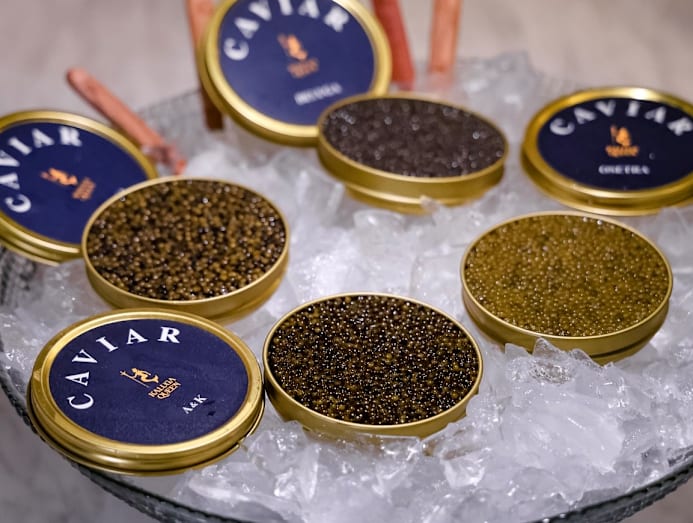
Its caviar has been served at award-winning restaurants around the world, including Michelin-starred establishments in France and the US; notably, Thomas Keller of The French Laundry and Per Se fame partners with Kaluga Queen for his Regiis Ova caviar brand. In Singapore, establishments like the Shangri-La hotel, Vue and Tempura Ensei serve Kaluga Queen caviar.
In 2022, Kaluga Queen became the official caviar supplier for Singapore Airlines; it is also the supplier for Cathay Pacific and Lufthansa, which it managed to impress after a series of blind taste tests in 2011.
To see this caviar colossus with my own eyes, I made a trip to Qiandao Lake in Zhejiang Province, about two and a half hours’ drive from Hangzhou — home to Kaluga Queen and hundreds of thousands of fish who have no idea they’re in the luxury business.
THE PRISTINE CHINESE LAKE YOU’VE NEVER HEARD OF
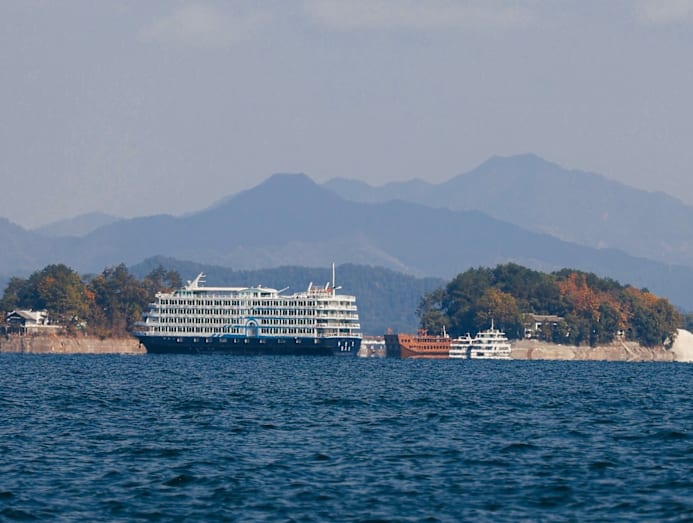
Getting to the fish farm in a secluded area of the vast lake involves a 30-minute speedboat ride across beautiful blue waters dotted with tiny islands, many of which are actually the tops of mountains. Qiandao or Thousand Island Lake is a man-made one, in which a valley was flooded and a dam built for hydropower in 1959, submerging a couple ancient towns in the process, the ruins of which can still be seen by divers. These days, the lake is a holiday spot as well as a famous source for bottled water brands like Nongfu Spring Water.
It’s immediately apparent how immaculate the body of water is. Qiandao Lake is absurdly pretty — 1,078 islands, turquoise water, a backdrop of inky mountain ranges straight out of a Chinese painting and mist whose job is clearly to make photographers feel smug. Covering an area of 573 sq km, its waters are said to have a clarity of up to seven metres as well as high oxygen levels. It is known as one of the cleanest freshwater bodies in the country, which is excellent for sturgeon and inconvenient for anyone hoping to complain about pollution.
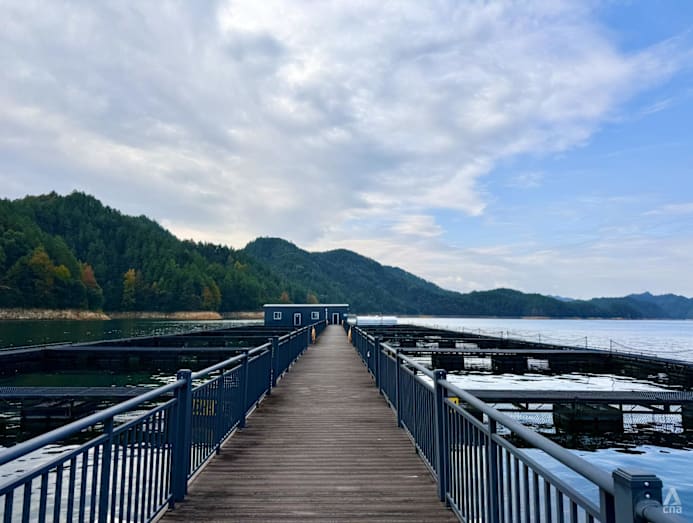
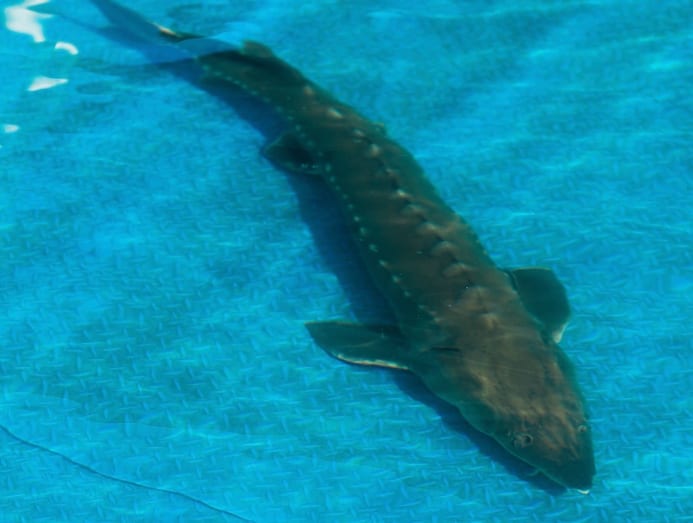
Standing on the farm’s floating platforms, watching giant sturgeon cruise below, is a surreal combination of serenity and “one of these could probably body-slam and/or bankrupt me.”
Scientists think that sturgeon have been on this planet for about 200 million years, which means they have lived through multiple mass extinctions, the rise and fall of empires and at least 30 seasons of certain reality TV shows. In the wild, they can grow over two metres long and live past a hundred, presumably because death takes one look at them and decides to pick an easier target.
Caviar began as a Persian staple in the 10th century, moved on to Russian peasants in the 12th, Russian Tsars in the 16th, and western European and American high society in the 19th. It was casually eaten on Volga River docks before becoming a symbol of refinement, wealth and the type of party where someone inevitably says, “This champagne is too cold.”
Then overfishing happened — in Russia, in the US, in pretty much every river where sturgeon dared to swim — and by the late 20th century, wild sturgeon populations had collapsed. CITES (the Convention on International Trade in Endangered Species of Wild Flora and Fauna) stepped in, wild caviar trade was restricted and aquaculture stepped out of the wings with jazz hands.
Here, in the middle of Qiandao Lake, sturgeon are farmed according to a net cage culture method simulating wild Caspian Sea habitats, with the modern conveniences of cutting-edge technology like automated feeding and automated waste processing.
Kaluga Queen was first established as a research institute in 1998 in Beijing and later set up its farming headquarters in Quzhou, about a two-hour drive from Qiandao lake, in 2003. In 2015, it became the world’s top producer. Today, it produces 260 tonnes of caviar a year and supplies products and services to 46 countries and regions.
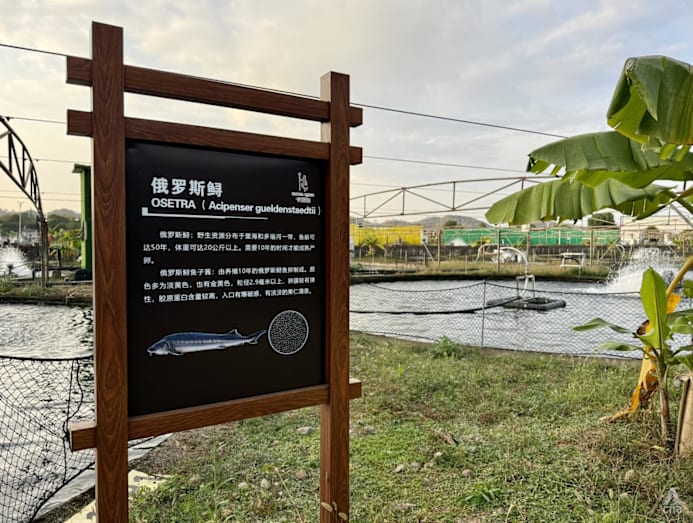
The company farms over one million sturgeon across facilities in Jiangxi, Liaoning, Hubei and beyond. Species farmed include Kaluga, Amur, Osetra, Baerii and Beluga. Kaluga Queen was also a pioneer in crossbreeding species such as the "Xunlong No 1", also known as A&K — Amur crossed with Kaluga — which offers large, Kaluga-style roe but matures in just nine years, rather than the heavyweight 15-year Kaluga timeline. It’s the fast fashion of luxury fish eggs, but in a good way, enriching sturgeon varieties and bolstering healthy industry development.
SUSTAINABLE FARMING
Just how do they do all this?
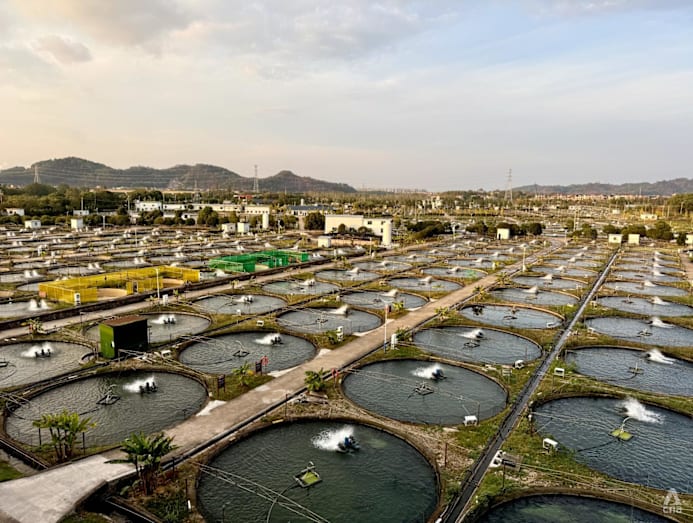
The process starts with artificial fertilisation methods at the Quzhou headquarters. Sturgeon fry are hatched in tanks through high-tech methods. For the first year, they are raised indoors, sheltering them from disease, predators and bad decisions. In the science lab, staff are able to ascertain which are female — the money-makers — and which are male (a small percentage of these are kept for breeding purposes, or sold and exported as meat).
The fish are then sent to Qiandao Lake for several years, where the clean waters help them grow large and healthy.
In the warmer months, the lake heats up, which makes them prone to diseases. So, the fish are transferred to cooler waters for the season, which Kaluga Queen refers to as their “summer palace”.

When they reach the age of sexual maturity — anywhere between seven and 20 years, depending on the species — they are brought back to Quzhou, where they live for up to a few more years in large enclosures with generators that mimic the upstream currents they would naturally swim in to spawn. It’s like a fish treadmill, but without the gym membership. This stimulates egg production.
Thanks to these techniques, Kaluga Queen is able to harvest and process caviar all year round, a feat sturgeon ancestors probably never imagined when they were avoiding T. rex.
The company also helps repopulate endangered wild sturgeon by releasing some of their homebred fish into the Heilongjiang river on China’s border with Russia. Fun fact: The Heilongjiang river and the Amur river are one and the same, with Amur being the Russian name.
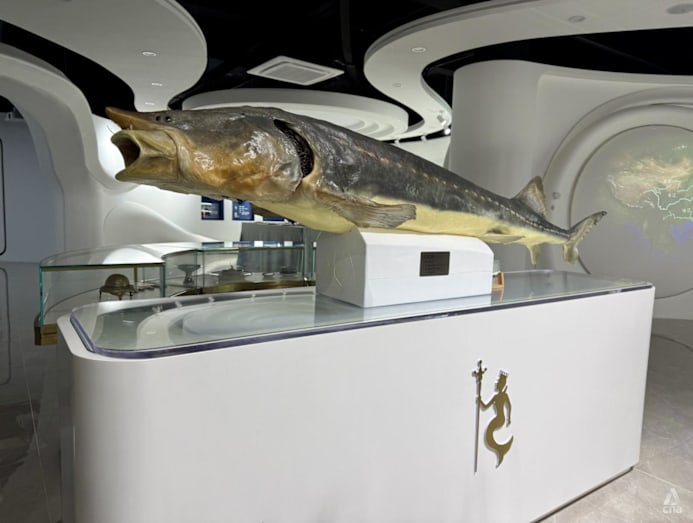
Additionally, in a circular-economy twist, sturgeon poop is collected and used as fertiliser for pomelo trees, whose fruit goes into a regionally famous bottled juice. Somewhere, a sustainability consultant is weeping with joy.
And, because no modern empire is complete without a side hustle making use of byproducts, they have R&D labs working on developing products like caviar face masks.
CONVINCING YOUNG CHINESE CONSUMERS THAT CAVIAR IS FUN, ACTUALLY
Although China already quietly leads in caviar production, getting the world on board with the idea of Chinese caviar is still an uphill battle — which is why Kaluga Queen is more than happy to have international media visit their farms and view their operations.
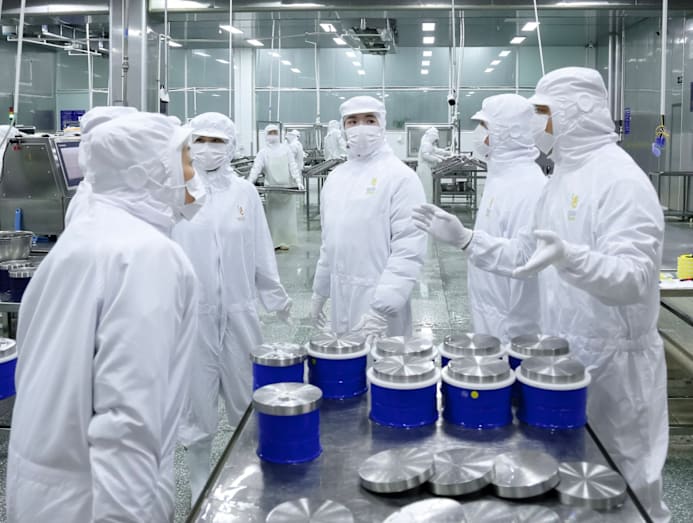
Many well-known global brands outsource their caviar production to Chinese companies like Kaluga Queen without shouting about it, and if you scrutinise the fine print on the tin, you will likely see something to the effect of “Made in China”. Kaluga Queen alone provides products and services to over 100 distributors worldwide, having long-term partnerships with brands including Kaviari, Imperial Caviar, W3 Caviar and Caspian Tradition.
It must be acknowledged that food produced in China has not yet been able to shake off the bad reputation gained after the tainted milk powder scandal of 2008, said Kaluga Queen’s marketing director Lily Liu. She’s keenly aware that the company has their work cut out for them.
In addition to export sales, the company is setting its sights on the direct-to-consumer domestic market — which has no traditional reference point when it comes to caviar consumption.
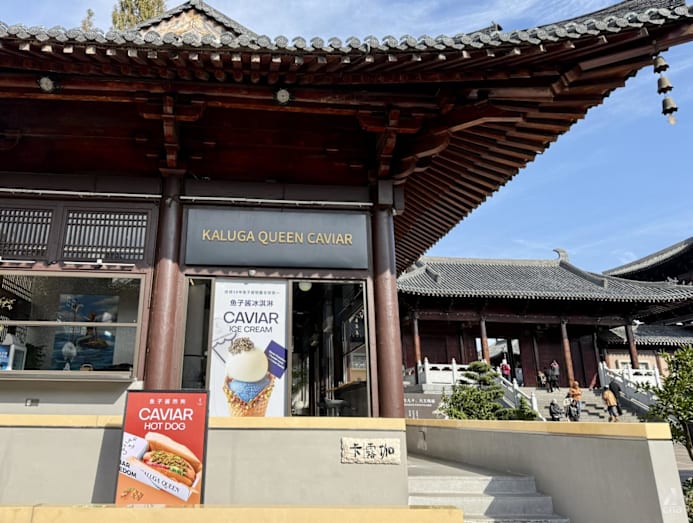

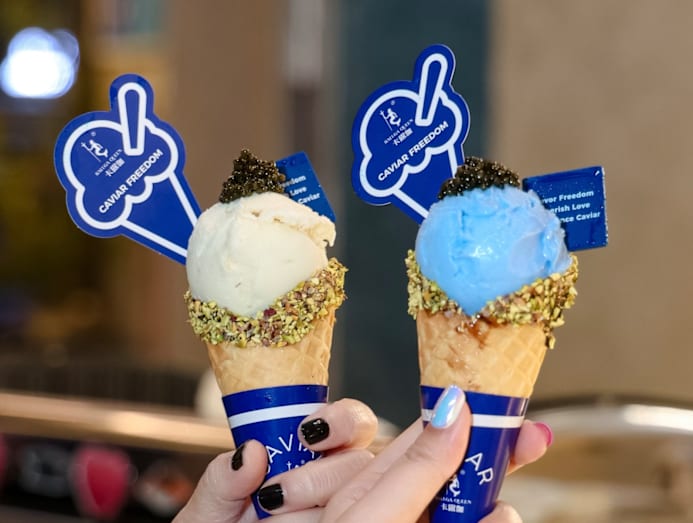
To win over younger Chinese consumers unfamiliar with caviar (or wary of its price tag), Kaluga Queen has opened concept stores in Quzhou and Beijing offering caviar chocolates, caviar ice cream cones, caviar-topped cakes, caviar affogatos, caviar chicken nuggets and presumably caviar on anything that stays still long enough. It is a marketing strategy best summarised as: If you can’t make them love fish eggs, put fish eggs on dessert and see what happens.
It is clearly a calculated march towards caviar hegemony.
Kaluga Queen’s operation is vast, high-tech and tightly run — the kind of place where ancient fish, automated feeding robots, relentless R&D and a Guinness World Record for producing the world’s largest tin of caviar (62.9kg in 2021, FYI) all co-exist without anyone batting an eye (least of all the sturgeon, who can barely see).
Even with China’s economies of scale and plentiful resources, it’s clear why caviar is so expensive: What you are paying for is, in fact, time. Because sturgeon take so many years to mature, one wrong move could obliterate years of work. Then there are other considerations, like how waiting for successive ovulations instead of harvesting the first can result in increased volume and egg size, as well as richer flavour.
What Kaluga Queen represents is a very modern sort of luxury industry. The sheer time and care invested in raising each sturgeon reframes caviar not as a mysterious delicacy but as the end point of years of human effort.
Whether the wider world is ready to accept that its prized caviar now largely comes from China is almost beside the point; China is already producing it, producing it well and producing it at a scale that no one else can match. The rich contents of Kaluga Queen’s royal blue tins originate in a man-made lake in Zhejiang, and, seeing the operation up close, it feels less like a disruption and more like the inevitable future of a luxury long defined by scarcity.
If anything, the true surprise isn’t that Chinese caviar is everywhere — it’s that the rest of us took so long to notice. After a day spent with million-year-old fish and the very contemporary systems tending them, the global shift feels less like a plot twist and more like the natural next chapter in the long, strange and glamorous life of caviar.
CNA Luxury was in Qiandao Lake, China at the invitation of Kaluga Queen.