Inside Bovet 1822: The story behind the Recital 30 and Miss Audrey
With its Recital 30 claiming the GPHG Men's Complication Prize in 2025 and the transformable Miss Audrey already a Ladies' Watch Prize winner, Bovet 1822 shows why serious collectors look to this independent Swiss maison for watches that marry technical innovation with wearable artistry.
In partnership with Sincere Fine Watches
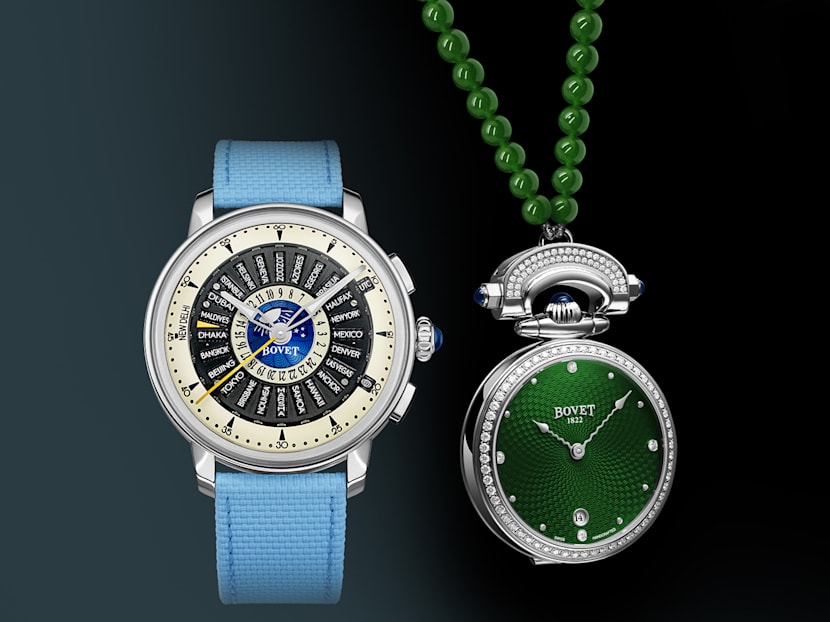
Bovet 1822's Recital 30 and Miss Audrey. (Photo: Bovet 1822)

This audio is generated by an AI tool.
There are times when a remarkable timepiece captures the very spirit of a maison, distilling years of vision, discipline and artistry into one defining gesture. On Nov 13, at the Grand Prix d’Horlogerie de Geneve (GPHG), often likened to the Oscars of watchmaking, the Bovet 1822 Recital 30 clinched the Men’s Complication Prize. For discerning collectors, it was well-deserved recognition for the independent watchmaker that has long operated just outside the glare of mainstream luxury, creating some of the most distinctive and artistically ambitious timepieces in Swiss haute horlogerie.
For the seasoned connoisseur already immersed in the world of independent houses, Bovet is hardly a discovery. It’s a name that surfaces when conversations turn to metiers d’art, hand-engraved bridges, miniature painting, intricate guilloche and movements that are designed to be displayed as much as worn.
Under the ownership of Pascal Raffy, Bovet has been shaped into a truly vertically integrated manufacture. Between its historic workshops in Motiers, and movement and dial manufacture in Tramelan, the maison’s cutting-edge operation produces about 95 per cent of its components in-house, including the hairspring and regulating organ. This level of control is really about the freedom to pursue ideas that don’t need to chase mass appeal and where concepts can be wildly elaborate or quietly poetic, but always unmistakably personal.
Two distinctly different creations in Bovet’s current line-up embody this philosophy. The first is the Miss Audrey with a green guilloche dial, an ultra-feminine piece that pairs a richly engraved dial, diamonds and a strand of jade beads with a serious automatic movement and Bovet’s ingenious Amadeo convertible system. The second is the Recital 30, a world timer that finally tackles one of the horology world’s most persistent issues: the way Daylight Saving Time undermines the promise of “universal” timekeeping. Together, the timepieces showcase how Bovet turns the art of time into wearable masterpieces and why it remains a connoisseur’s secret for those who prize true craftsmanship over big mainstream names.
REDEFINING WORLD TIME WITH THE RECITAL 30
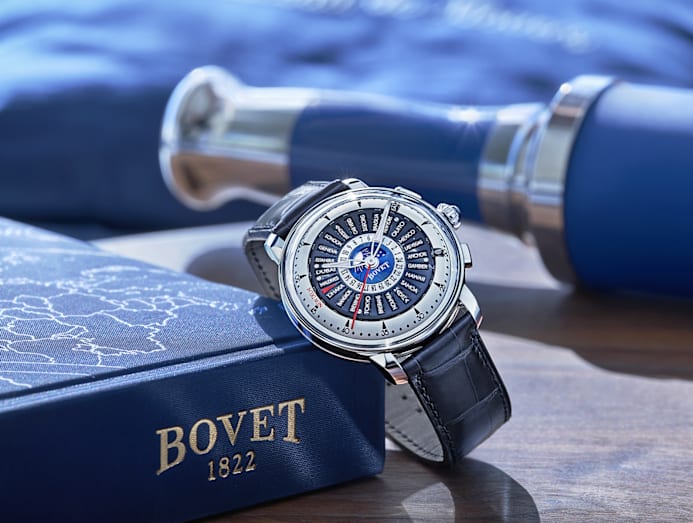
The Recital 30 addresses a deceptively simple problem. World-time watches were conceived to offer a clear snapshot of the hour in major cities around the globe, but the introduction of Daylight Saving Time disrupts this harmony. To reflect it, around 70 countries shift their clocks forward and back each year, while roughly 120 do not. Traditional world timers are built on a fixed relationship between cities and Coordinated Universal Time (UTC), which means that for months at a stretch, time for entire regions is incorrect. Most watchmakers have long accepted this as an unavoidable shortcoming, but Bovet did not.
In 2024, the maison engineered a solution with the Recital 28 Prowess 1 – the first mechanical watch to truly solve the Daylight Saving Time problem, a ground-breaking achievement that revolutionised world-time timekeeping. This 46.3mm grand complication, which combined a tourbillon and perpetual calendar with a completely new approach to global time, introduced a world-first innovation: a system of rollers that could reconfigure time indications according to how civil time actually shifts throughout the year. Winning the Mechanical Exception Award that year, it marked a leap in the way haute horlogerie handles terrestrial time.
As its follow-up, the Recital 30 focuses exclusively on that revolutionary world-time system in a new, more compact reference. Six years in development, it combines unmatched mechanical innovation with Bovet’s hallmark in-house craftsmanship to create a watch that is technically formidable yet simple to understand, intuitive to set and effortless to use day to day.
A WORLD-TIME MECHANISM LIKE NO OTHER
At the heart of the Recital 30 are 26 miniature rollers arranged in a ring around the dial, 24 of which carry the names of global reference cities. One roller indicates the prevailing “time regime” of the year, while another bears the 24-hour scale. Each roller has four positions, all controlled by two pushers on the right side of the case. Pressing the upper pusher rotates all the rollers by 90 degrees simultaneously, shifting them into one of four phases that define modern civil time. Coordinated Universal Time (UTC) corresponds to periods when no daylight saving is in effect; American Summer Time (AST) represents the months when the US observes Daylight Saving Time; European and American Summer Time (EAS) covers the period when Europe and the US are on summer time; and European Winter Time (EWT) reflects the phase when Europe has returned to standard time, while many other regions remain unchanged.

The lower pusher advances the central 24-hour world dial by one hour with each press, which makes setting the entire world’s time extraordinarily straightforward. By combining these two controls, the Recital 30 can accurately display 25 independent time zones, including New Delhi’s distinctive 30-minute offset, across all four seasonal phases of the year. Where traditional world timers are inevitably wrong for months at a time, the Recital 30 remains correct in January or July, without requiring mental arithmetic or tedious reconfiguration at the start and end of summer. The Recital 28 and Recital 30 represent a significant leap in solving real-world timekeeping problems and bringing accuracy to the management of global time zones.
On the dial, the aesthetic is dramatic yet remarkably legible. The rollers form almost the entire circumference, making world time the visual focal point rather than a peripheral complication. At the centre sits a 24-hour disc linked to local time, which also serves as a clear day-night indicator. With a single glance, the wearer can read the local hour, understand where the sun is in their own sky, and see what time it is for colleagues or loved ones across cities from Los Angeles to Tokyo. It’s an interface created for real travellers and global citizens rather than a showcase of mechanical bravado.
Bovet also extends special consideration to India. In the universal version of the Recital 30, New Delhi appears in a contrasting colour and is paired with an additional minute hand in the same hue to track its 30-minute offset with precision. Instead of treating this quirk as an inconvenience, the watch elevates it to a feature. There’s also a dedicated India edition, in which New Delhi becomes the primary reference city for the main hands and the rest of the world effectively orbits around that home time. This is a small, but telling, example of Bovet’s willingness to think like a bespoke watchmaker and let the geography of the display reorient itself around the wearer’s needs.
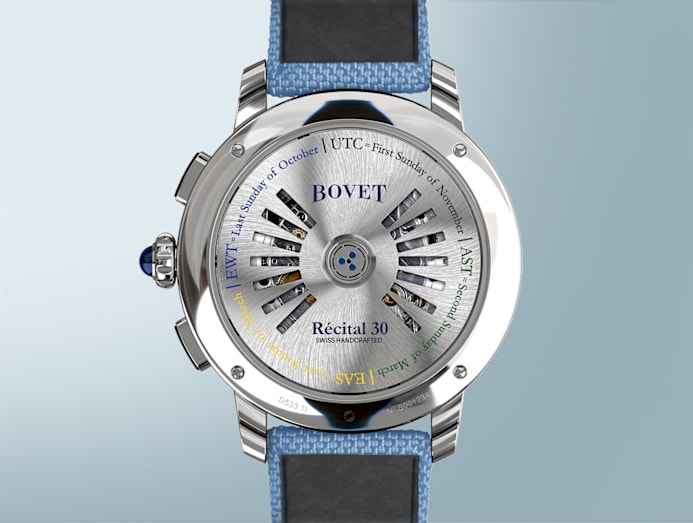
This mechanical virtuosity sits within Bovet’s Dimier case, an architecture that resembles a piece of micro-sculpture more than a traditional round watch. The Recital 30 brings the scale of the earlier Recital 28 Prowess 1 into a more wearable 42mm case size with a thickness of 12.9mm, its gently asymmetric profile and domed sapphire crystal giving the rollers and central disc the space they require. Turning the watch over reveals a sapphire caseback that exposes the movement along with an engraved world-timer glossary – a thoughtful and useful guide that indicates when each of the four seasonal time regimes occurs. The watch is offered in red gold or Grade 5 titanium, each iteration expressing Bovet’s distinctive interpretation of contemporary high watchmaking.
Powering the timepiece is the self-winding calibre R30-70-001, a high-watchmaking automatic movement with a 62-hour power reserve. It drives the central hours and minutes, the world-time indication on the rollers, the day-night disc and the additional minute hand for New Delhi. Despite comprising 373 components, the movement has been engineered so that the watch remains straightforward and intuitive to set and operate. The option of a rubber strap alongside a leather one reinforces the idea that this isn’t a delicate showpiece to be stored in the safe, but a true travel companion meant to be worn in the real world.
The GPHG jury’s decision to award the Men’s Complication Prize to the Recital 30 underscores how compelling this combination of intellectual rigour and real-world usefulness is. At a ceremony that celebrates the very best of haute horlogerie, Bovet’s solution to the long-standing messiness of world time stood out not only for its mechanical ingenuity, but also for the clarity of its display and the coherence of its design.
GOING GREEN WITH MISS AUDREY
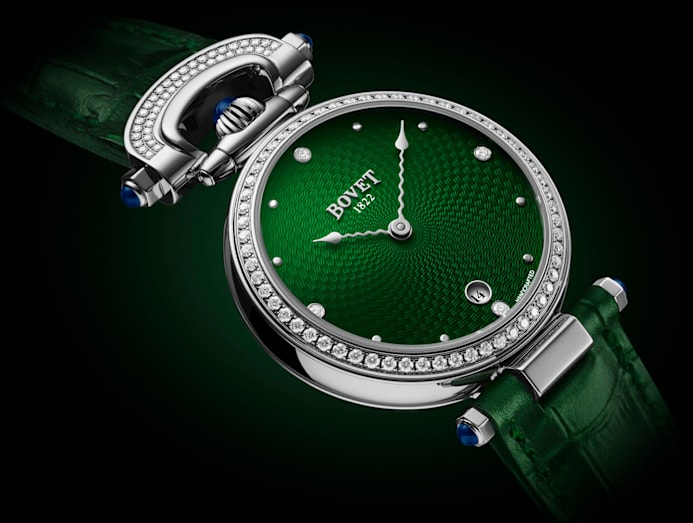
Where the Recital 30 highlights Bovet’s technical ingenuity, the Miss Audrey with a green guilloche dial reveals its flair for beauty and versatility. Part of the maison’s Fleurier collection and winner of the 2020 GPHG Ladies’ Watch Prize, it channels that same dedication into a more intimate form of watchmaking. At first glance, the Miss Audrey could be easily mistaken for a jewellery piece with its compact steel case, diamonds framing a richly patterned dial and a long necklace of cool green jade. Spend a little time with it and it quickly becomes clear that this is very much a Bovet creation at heart.
The Miss Audrey is housed in a 36mm stainless steel Amadeo convertible case, a patented Bovet signature that allows the timepiece to take on three distinct personalities. Used across the Fleurier collection since 2010, this ingenious system is what lets the watch transform so effortlessly between roles. With its alligator leather strap attached, the Miss Audrey is an elegant wristwatch, its bow at 12 o’clock recalling 19th-century pocket watches. Detached from the strap and suspended from its beaded jade necklace, it becomes a pendant that sits beautifully below the collarbone. Set down on a flat surface with the caseback acting as a support, it transforms yet again into an exquisite table clock. All three of changes can be made effortlessly without tools, thanks to carefully engineered mechanisms integrated into the lugs and bow.
A FEMININE WATCH WITH SUBSTANCE
The case is framed by 103 round-cut white diamonds set into the bezel and bow, with a combined weight just shy of one carat. They create a halo of light around the watch without overwhelming it, which matters because the dial is very much the star. Here, Bovet has chosen a deep, nuanced green and finished it with guilloche, the centuries-old art of engine-turning patterns into metal. The hypnotic engraved motif radiates from the centre and catches the light in shifting waves. Four diamonds at the quarter hours punctuate the composition, but the real fascination lies in watching the guilloche come alive with every tilt of the wrist or turn of the pendant.
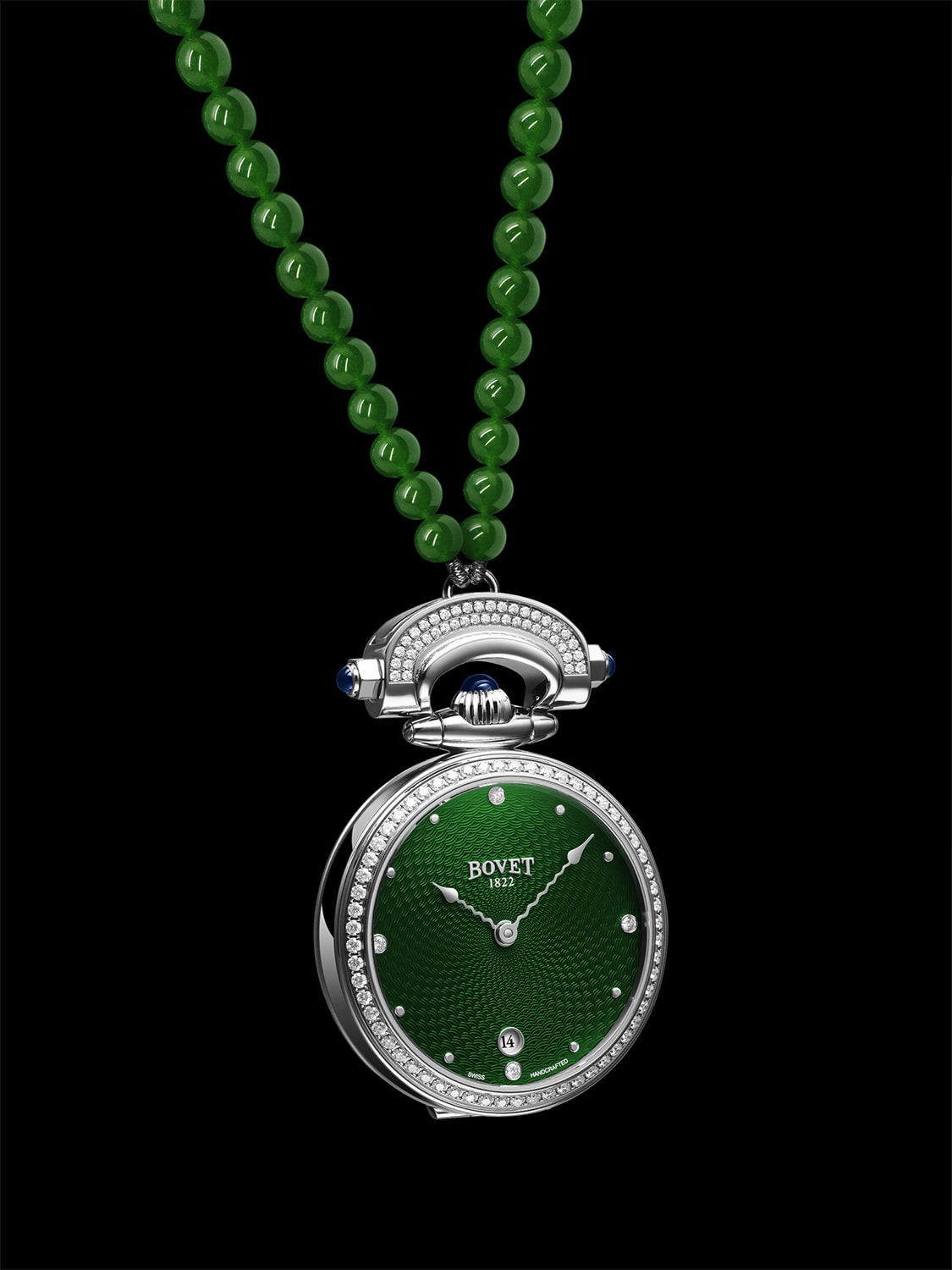
The accompanying necklace is strung with jade beads, chosen not only to echo the colour of the dial but also for their cultural resonance. The gemstone has long been associated with protection, balance and good fortune across many Asian cultures, while Bovet’s historic ties with Imperial China in the 19th century lend this choice an added layer of meaning.
Beneath the surface, the Miss Audrey is every inch a piece of true haute horlogerie. It’s powered by the self-winding calibre 11BA15, which delivers a power reserve of around 42 hours. This movement drives central hours and minutes, along with a round date aperture at 6 o’clock, all presented with crisp legibility on the dial. More than a fragile, hand-wound watch that demands constant fussing, it’s a robust automatic watch designed to slip easily into everyday life, even as its appearance hints at a far more ceremonial or formal role.
TWO MASTERPIECES, ONE PHILOSOPHY
Each speaking to entirely different audiences, the Recital 30 and Miss Audrey are GPHG prize winners – a rare pairing that reveals the Bovet’s ability to excel across the full spectrum of haute horlogerie. One reimagines global timekeeping with intellectual precision and a world-first innovation, while the other brings that same level of refinement to a feminine, transformable jewel. Yet, both are guided by the same principles: in-house movements conceived for their specific roles, cases and dials treated as three-dimensional canvases and a willingness to lavish time and skill on details that only a true connoisseur will fully appreciate.
The Recital 30 and Miss Audrey are available at selected Sincere Fine Watches boutiques.