How Swiss watchmaker Vacheron Constantin reimagined a 150kg clock for the wrist
Christian Selmoni, Vacheron Constantin’s Heritage & Style director, talks about how the maison brought astronomy, metiers d’art, innovation and emotion together in the Metiers d’Art – Tribute to The Quest of Time watch.
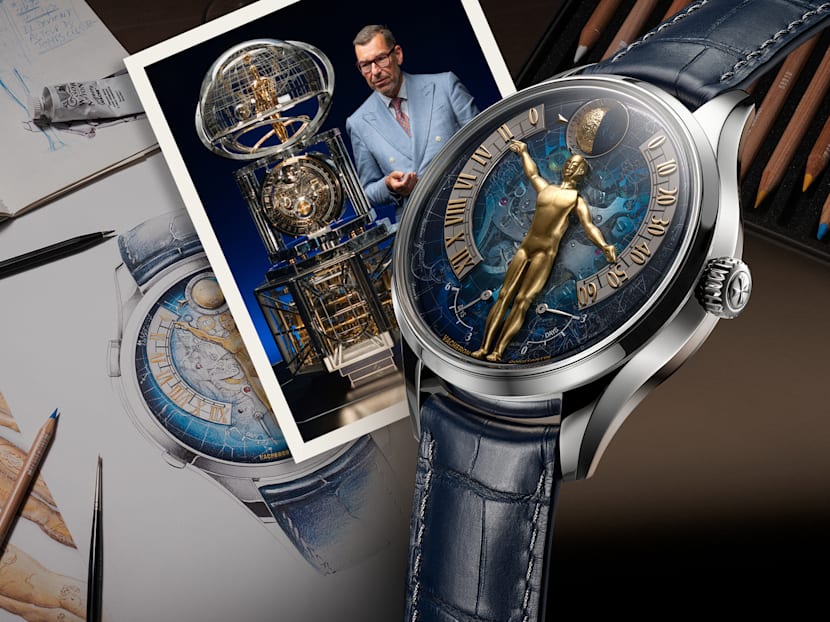
Christian Selmoni, Vacheron Constantin’s Heritage & Style director shares how Vacheron Constantin shrank its monumental La Quete du Temps clock into a limited-edition Metiers d’Art wristwatch, blending astronomy, art and mechanics. (Photos: Vacheron Constantin; Art: CNA/Chern Ling)

This audio is generated by an AI tool.
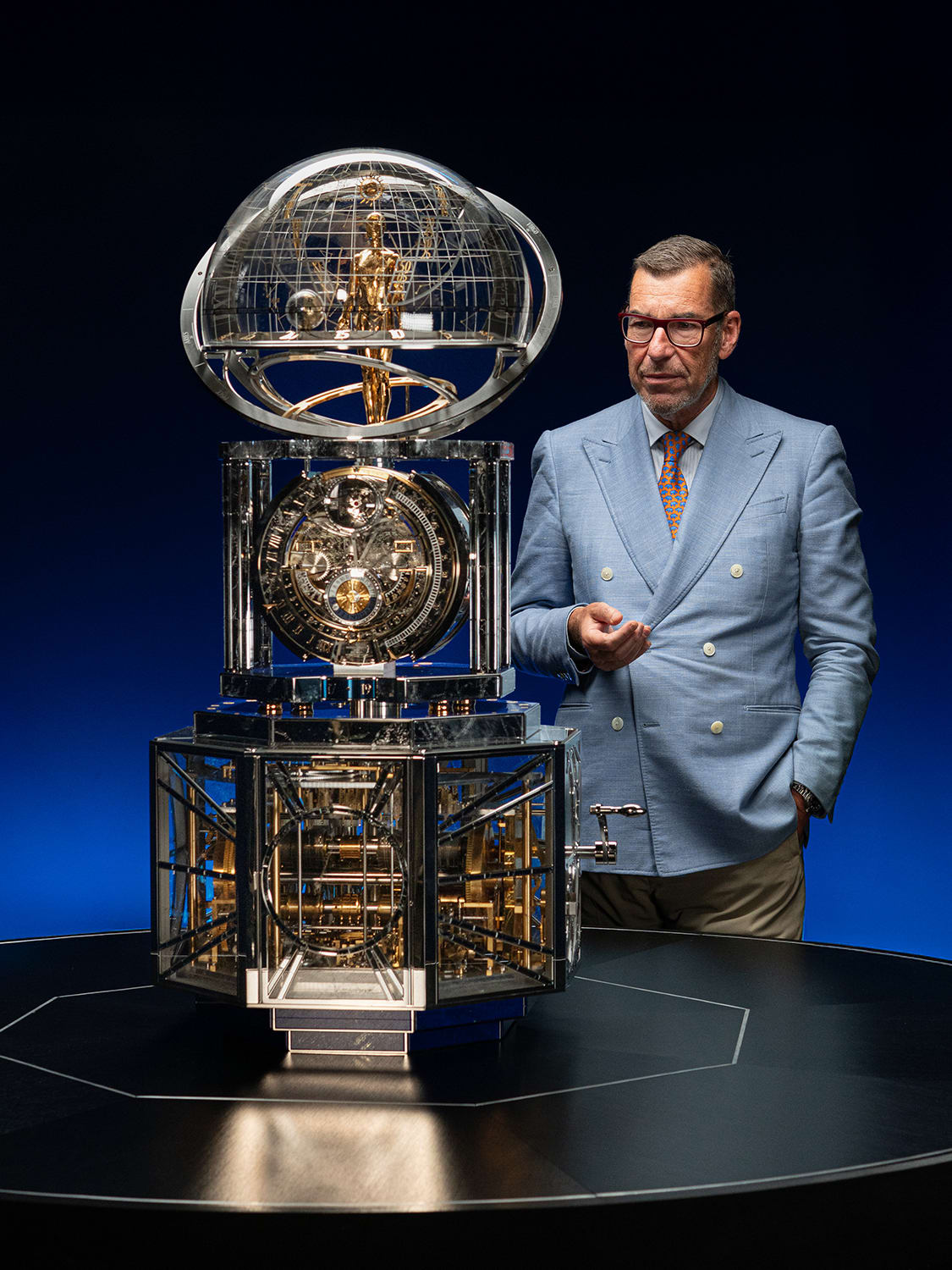
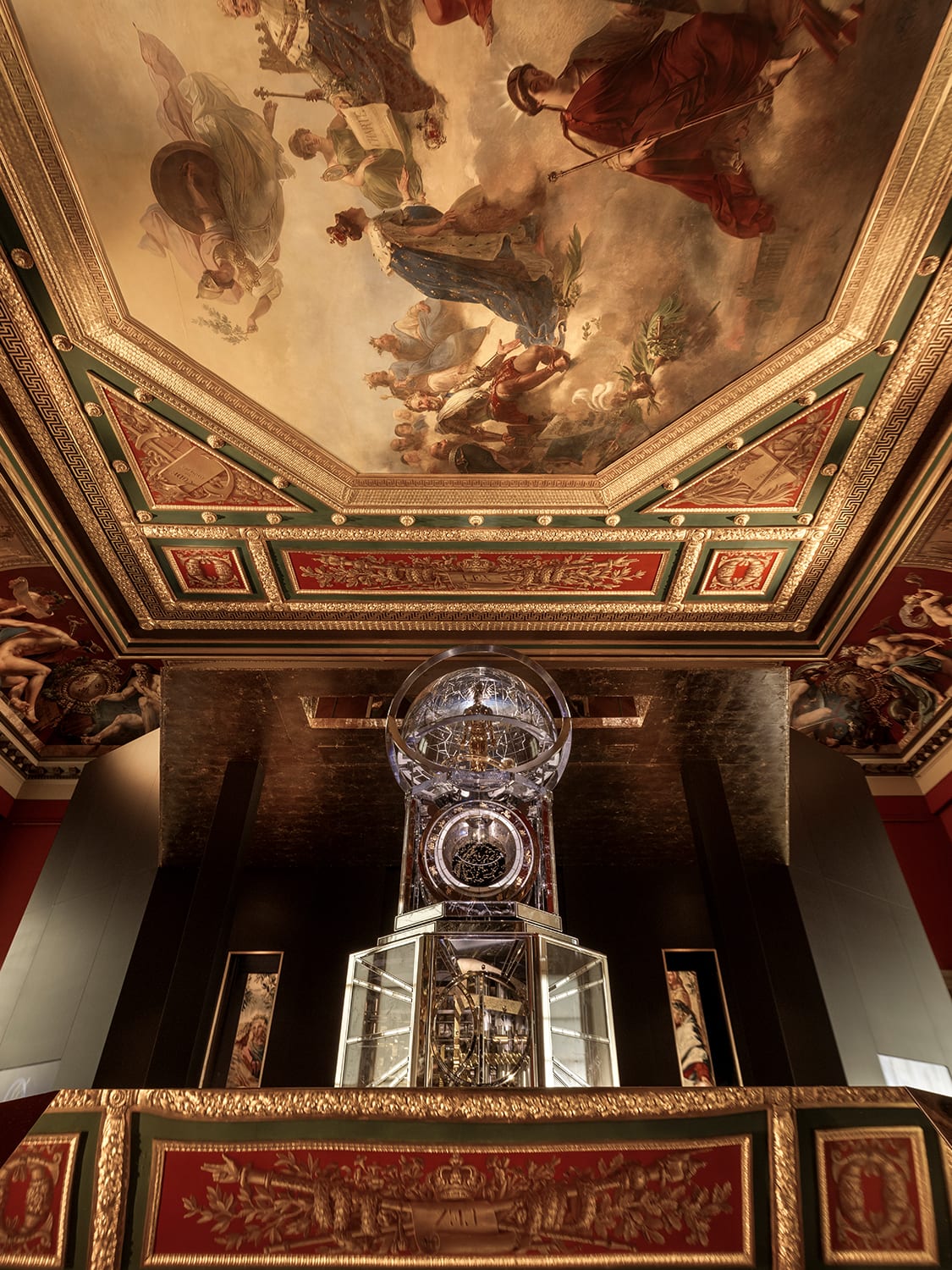
It takes a certain audacity to imagine time as something you could sculpt, choreograph, and bring to life. Yet that is exactly what Vacheron Constantin has done with La Quete du Temps, a clock so ambitious that it defies every known boundary of horology. Measuring 1.07m tall with a weight of 150kg and comprising 6,293 components, the astounding creation marks the maison’s 270th anniversary with a singular declaration: that time is not only measured but also felt, experienced and revered.
Seven years in the making, this astronomical creation is a collaborative symphony of artisanship and science. Within its crystalline dome stands the automaton, the Astronomer, whose fluid, almost human-like movements are powered by an intricate system of 158 cams and a mechanical memory that synchronises with a 23-complication clock beneath it. The Astronomer gestures and looks towards celestial spheres, the moon, and the division between night and day, while music composed by Grammy-winning French musician, producer and director Woodkid resonates through the automaton’s base, transforming time into an emotional performance
La Quete du Temps is more than a feat of mechanical engineering for the maison; it’s a philosophical statement about mankind’s eternal dialogue with the cosmos. Beneath its glass dome, the constellations are painted exactly as they appeared above Geneva at 10am on Sep 17, 1755. It was the day Jean-Marc Vacheron founded Vacheron Constantin and the time he signed the contract to employ his first apprentice, unknowingly setting in motion one of haute horlogerie’s most enduring legacies.
But in the grand tradition of Vacheron Constantin, monumental inspiration often finds its way into wearable form. From this singular creation was born a timepiece that distils its essence into something more intimate: the Metiers d’Art – Tribute to The Quest of Time. A 20-piece limited edition in white gold, this double-sided 43mm wristwatch took three years to develop. At its heart lies the all-new manually wound Calibre 3670, a technical triumph of 512 components and four patent applications.
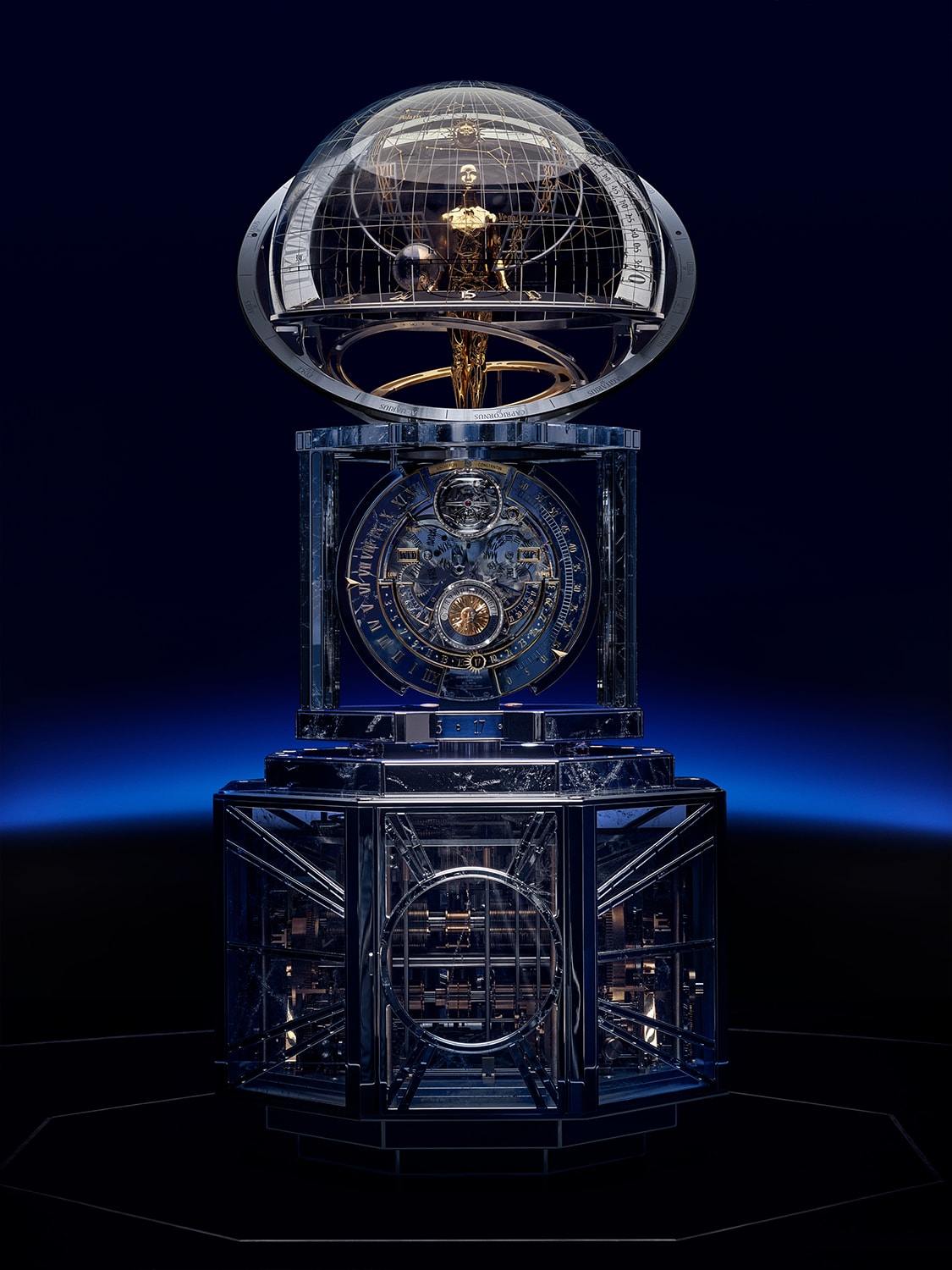
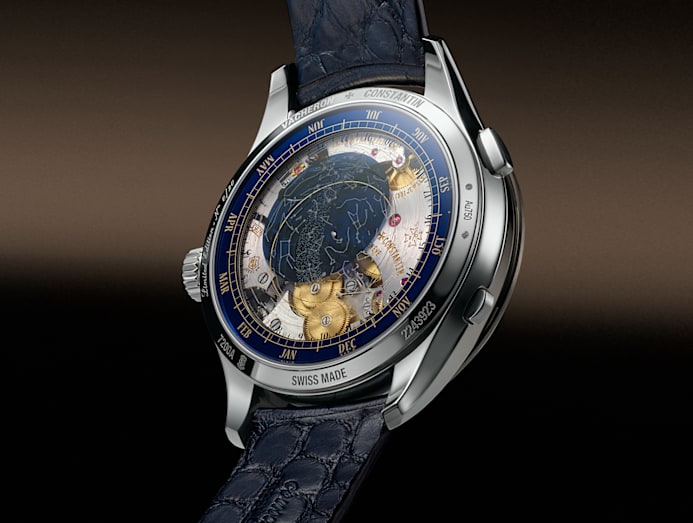
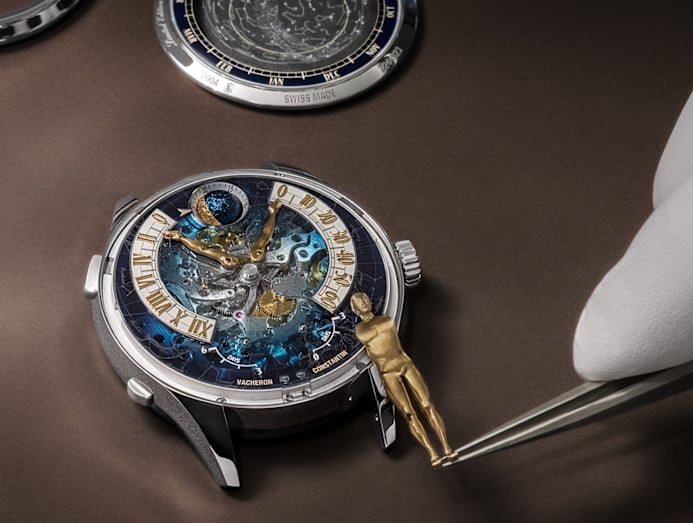
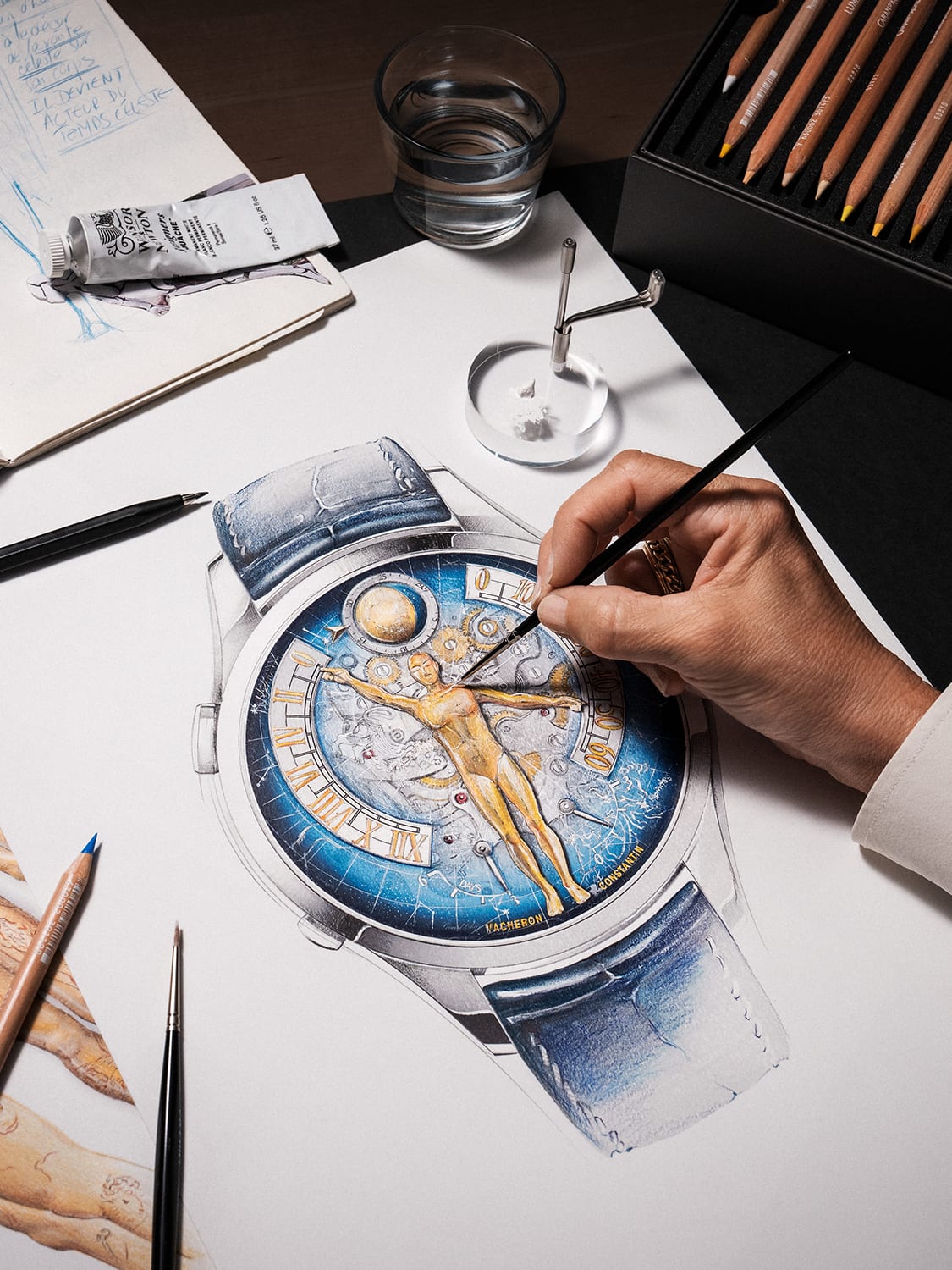
On the front, a golden titanium figure – crafted using traditional hand-finishing and contemporary decorative techniques – lifts its arms in a double-retrograde display to indicate the hours and minutes. This modern reinterpretation of the maison’s 1930 bras en l’air pocket watches also serves as a showcase of Vacheron Constantin’s metiers d’art savoir-faire. The figure is set against a graduated blue, metallised sapphire backdrop depicting the constellations above Geneva on the day of the maison’s founding in 1755, while the reverse side features a laser-engraved celestial map that mirrors that same night sky, accurate to within one day over more than 9,000 years.
The Metiers d’Art – Tribute to The Quest of Time is the poetic counterpart to La Quete du Temps – a wrist-worn cosmos where artistry, astronomy and engineering intersect. To uncover the philosophy behind these extraordinary creations, we sat down with Christian Selmoni, Vacheron Constantin’s Style & Heritage Director, who was in Singapore in October for The Quest: 270 Years of Seeking Excellence exhibition celebrating the maison’s 270th anniversary. Here, he reflected on the manufacture’s enduring fascination with the stars, the role of beauty in mechanics and the timeless human desire to capture eternity in motion.
The watch’s name, Metiers d’Art – Tribute to The Quest of Time, feels deeply symbolic, especially in Vacheron Constantin’s 270th year. How would you describe its philosophical essence?
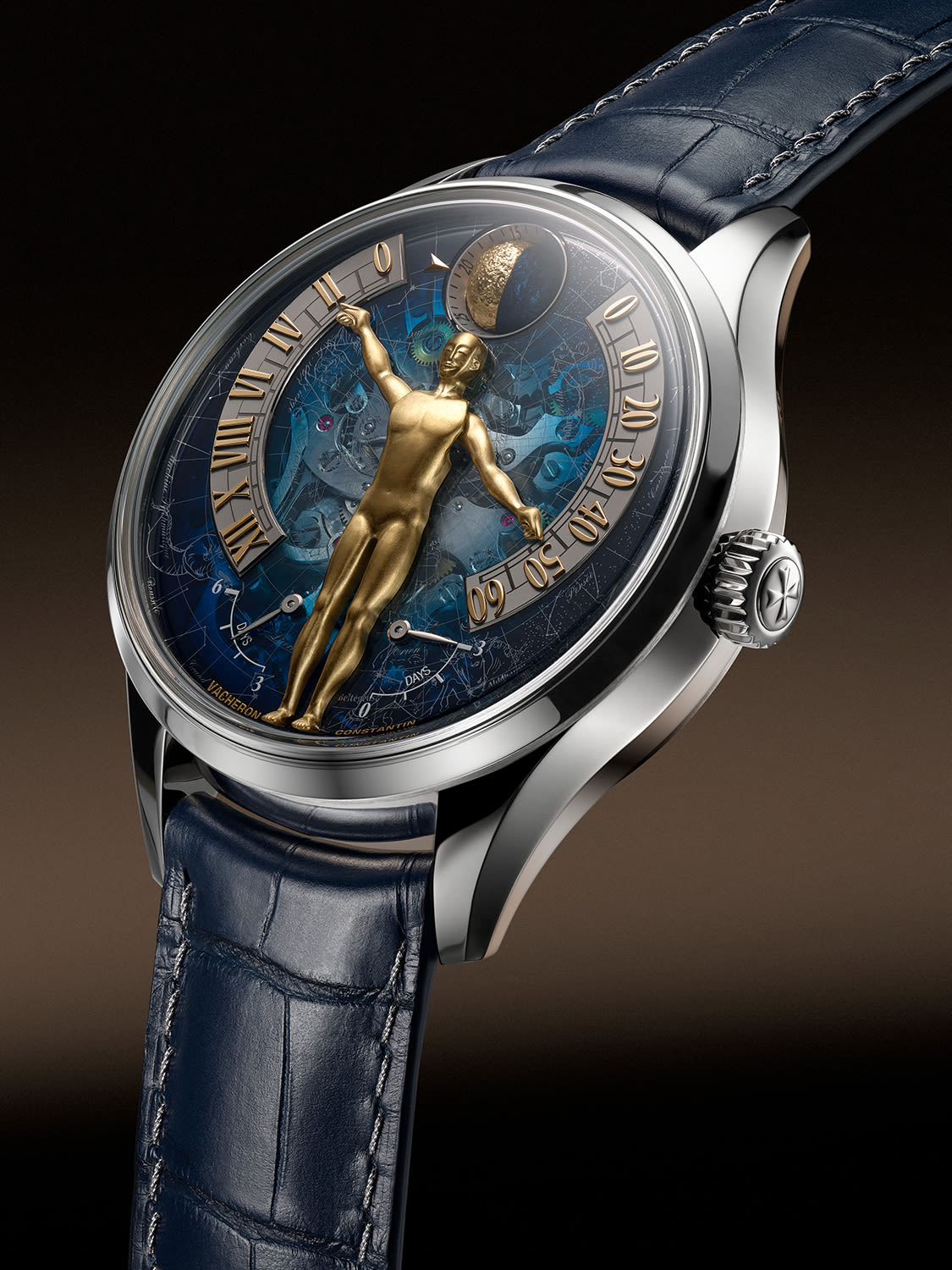
Everything starts with La Quete du Temps, the clock that inspired the watch. This extraordinary creation, which took us seven years to complete, was initially imagined as a more modest table clock, but it evolved into a monumental piece that’s as tall as a person.
La Quete du Temps became an object that exists beyond the universe of traditional watchmaking. It’s more a manifesto of artistry, mechanics, artisanship and craftsmanship. It’s also very much alive and contemporary, which is why it stands apart from what we typically do. It’s an adventure, a powerful testimony not only to Vacheron Constantin as a brand and watchmaker but to our values – combining technicality with references to astronomy, integrating automaton features and creating what I’d call mechanical poetry.
When La Quete du Temps was finally completed, we knew that this clock would remain a unique expression of who we are. That’s when we started thinking about creating a small, limited series of wristwatches, and this is how the idea of Tribute to The Quest of Time was born. It’s an homage to the great clock, where we took the Astronomer’s figure from its top and reinterpreted it using a system we call bras en l’air – French for “arms in the air” – a mechanism the maison created in the 1930s.
What were the challenges in miniaturising elements from the clock?
It wasn’t about downsizing because the clock is huge and complex, so that would be impossible. We focused instead on the Astronomer, the figure beneath the dome, and reimagined it as part of the wristwatch. Its arms indicate the hours and minutes in a double-retrograde display, a nod to our 1930 bras en l’air pocket watches.
But it goes beyond that. The watch includes a sky chart, a 3D moon and two power-reserve indicators. It’s a grand complication in its own right and a dialogue between the monumental and the intimate.
How does the Metiers d’Art – Tribute to The Quest of Time embody Vacheron Constantin’s motto: ‘Do better if possible, and that is always possible’?
When you look at those 1930s pocket watches with the bras en l’air complication, like the Snake Charmer and the Chinese Magician, their movements were relatively simple, with an additional mechanism that allowed the time to be displayed on demand via a pusher. We drew from those historical pieces, but set out to create something far more sophisticated and complex.
In the new watch, you have a three-dimensional figure, a double power-reserve system with a differential – just like in the La Quete du Temps clock – a sky chart on the back, and a second gear train: one for mean time and another for sidereal time. The movement also beats at 36,000 vibrations per hour. In fact, it has almost nothing in common with our existing calibres, except perhaps the Twin Beat, which shares this high frequency. So this is not about repeating the past with a modern design or new materials, but about completely rethinking the system from the ground up, which is a perfect illustration of our motto.
The watch also houses the new manually wound Calibre 3670 with four patent applications. What was most challenging in creating this new movement?
The most challenging part was reinventing the bras en l’air mechanism. To begin with, any movement with more than 500 components is already in the realm of high complication. On top of that, we developed a retrograde system with two operating modes, continuous or on demand, and this is the key difference between this timepiece and those from the 1930s. Back then, it was an all-or-nothing system: you pressed a pusher, the figure lifted its arms, and you read the time. Here, you can choose between two modes, which I find a very chic innovation.
On the clock, we have 15 days of power reserve, displayed on the front with two indicators on the left and right – seven and a half days each. Since this watch is a tribute to the clock, we wanted to mirror that layout as closely as possible. But instead of a single six-day power-reserve subdial, we decided to recreate the idea of two parts: one indicator running from six to three days and a second taking over when there are three days or less remaining. This required barrels linked by a differential system.
I personally love this kind of complication because it gives the watch a wonderfully symmetrical appearance. It’s a very sophisticated solution chosen primarily for aesthetic reasons. From a purely rational, technical standpoint, we wouldn’t need to execute it this way, but rationality was not the point here; beauty was. That’s why we created this differential system – it’s a perfect example of technique placed entirely at the service of aesthetics.
You collaborated with astronomers from the Geneva Observatory for this watch. How important was scientific precision in shaping this timepiece?
It’s extremely important. When you’re talking about representing the Genevan sky on a watch at the level of high-end, technical watchmaking with grand complications, you have to be extremely serious. There is no room for mistakes.
On a sky chart, you could theoretically include thousands of stars. But you have to make choices: select the brightest and most visible celestial objects, then decide which constellations you want to highlight because you simply cannot show everything. That’s why we worked closely with the Observatory of Geneva to identify the most relevant stars and constellations we wanted to enhance.
At Vacheron Constantin, if you want something to be 100 per cent accurate, you call in the experts. It becomes a question of credibility for the brand to get these things right, because at the end of the day, this is serious watchmaking.
How does the decision to feature two modes of standby and on-demand influence the wearer's emotional experience of time?
I think the dual mode gives the client freedom of choice. Some people love the idea of surprise or magic, so they’ll keep the system on standby mode; you activate the pusher and suddenly – ah, it’s 4 o’clock. Others prefer to leave the active mode on and glance at the time whenever they wish.
It’s really about convenience and comfort for the wearer, and ultimately about how you personally relate to time.
That’s one of the things I find beautiful about this watch – it’s quite philosophical. Today, we don’t need mechanical watches anymore. I’m not supposed to say that, of course, but it’s true. Yes, it’s precise, but not as precise as my iPhone when I haven’t misplaced it!
So why do we wear them? Because they are beautifully designed objects crafted by highly skilled men and women. They offer us a different perception of time. When I look at my iPhone and see that it’s 4 o’clock, that’s dry, digital information. But when I look at my watch, I think of my colleagues and the artisans who made it by hand.
One of the great charms of the Tribute to The Quest of Time is that you can even go a step further: you can have a mechanical watch on your wrist that doesn’t show you the time unless you ask for it. That, to me, gently questions our relationship with time and it’s a very romantic way of experiencing it.
How do you see this watch resonating with today’s collectors?
It was difficult to anticipate how our clients and the community would react to this timepiece. The La Quete du Temps clock is so extraordinary that I honestly thought this watch would be completely overshadowed by the monumental piece.
But I was wrong. The watch has sparked enormous interest. The reception has been fantastic because it’s so quintessentially Vacheron Constantin: a true fusion of high watchmaking complications and decorative crafts. People love this idea of a creative and unexpected way of telling the time. We’ve had wonderful feedback from clients, collectors and the press, which makes us very happy because it’s important that the public connects with what we do.
We always try to follow our own watchmaking path: to express ourselves while honouring our roots and legacy, but in a modern, novel and innovative way, maintaining a living link between past and present. In that sense, this timepiece is a real success. It carries the fantasy of the 1930s pocket watches, yet it is a thoroughly contemporary, sophisticated creation made for the 21st century.
This watch brings together so many elements. Which part is your favourite, and how did you feel when you first wore it?
That’s a difficult question, but if I have to choose, it really comes down to the aesthetics. I love the modernity of the timepiece. You have this central figure on the dial and at the same time you can see through the semi-transparent sapphire caseback to admire the movement. I like that it’s sophisticated without shouting for attention. We didn’t want to emphasise the complexity by adding diamonds. Instead, it’s very understated.
What I love most is the way fine mechanics and watchmaking are visibly connected to the craftsmanship – to the sculpted figure on the dial. That dialogue between movement and art feels very modern to me.
The first time I wore the watch, I found it absolutely amazing. It’s always the case when you see a watch in 2D or as mock-ups, you get an idea, but when the finished piece is finally on the wrist, another dimension comes to life. For me, it perfectly embodies the combination of technical watchmaking complications with metiers d’art. From that perspective, it ticks all the boxes.
On top of that, it’s very wearable. It’s not overly large and its proportions are elegant and classic. I also love the colour palette – the mix of white gold with yellow accents – and the evocation of the cosmos on the back. It’s a watch I genuinely appreciate on every level.