Can a city be designed to care? Inside one architect’s vision for a kinder Singapore
As Singapore grows smarter and denser, architect Randy Chan asks what the future of Singapore design and architecture could be if guided by empathy, not efficiency.
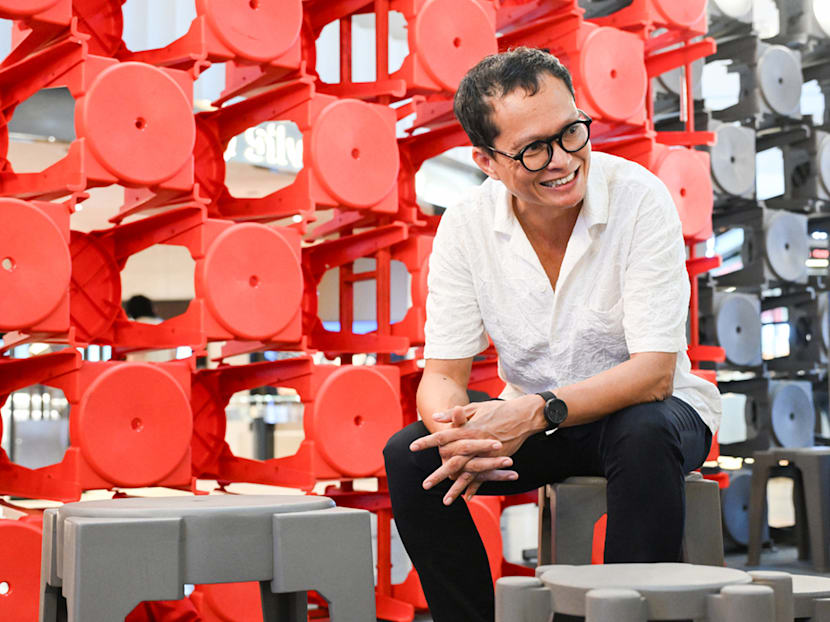
Architect Randy Chan is reimagining Singapore’s urban future through care, empathy, and heritage – proving that good design begins with heart. (Photo: Singapore Design Week)

This audio is generated by an AI tool.


Cities today are planned with concepts like mixed-use projects, smart technology, affordable housing, and biophilia in mind. Important as these are, architect Randy Chan feels there is a more vital metric to consider before any decision is made on where brick and mortar is to be laid: the notion of care.
Tempting as it is to dismiss it as highfalutin philosophy, he in fact built a very convincing case. “Care is an attitude that I wish every designer will have. It should be at the forefront of anything that we do,” said the principal of Zarch Collaboratives.
Chan founded his firm in 1999 on the similarly radical concept of a multi-disciplinary approach. Consequently, in addition to architecture, he has become a recognised name in the conservation, art, and curation circles. “It was a crazy idea back then to have this approach, because architecture was quite siloed as a discipline. Thank goodness the world has moved towards a more collaborative fashion,” the 55-year-old revealed.
It could be argued that it is precisely his out-of-the-box way of thinking that has enabled him to identify care as a prerequisite for urban design. Trained in architecture, he uses it as a tool to effect the mindset shift he hopes to achieve. He said: “It has given me the ability to see beyond what is being built, to how the space is a void, an intangible thing, that I question the possibilities of.”
COMING FROM A PLACE OF CONCERN
Chan’s devotion to care within the Singapore context is spurred by a lifetime of living and working in the country, allowing him to spot its gaps. In a highly urbanised environment that celebrates hyper-efficiency, people are busy all the time. City dwellers feel more alienated, lonely and wary of one another, especially after the COVID-19 pandemic.
Adding to the challenges is the rapid pace of development, which favours demolition over conservation, erasing memories and history. “It sends a shock to your body that a neighbourhood you’re familiar with for 30 years is gone,” he said.
A possible consequence is that future generations will become detached from their surroundings, having been conditioned into indifference as a way to avoid getting hurt. “We might feel that this place could be gone and there's nothing we can do about it,” he added.
On a more personal level, he remembers a time when his parents used Hokkien phrases that translated into “come to my house and sit” or “have you eaten” as a form of greeting and communication to express their care. Not only has this been lost to future generations, but Chan also feels such gestures have been eroded by the modern rat race. The reason, to him, is unfathomable and he hopes to rebuild the city with a similar spontaneity to connect.
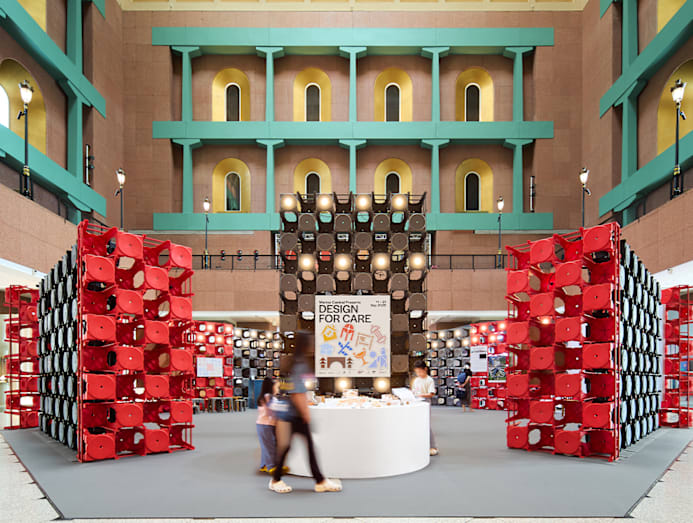
The “a-ha” moment that care was actually important to him came after he completed the curation of Design For Care at Marina Central, a key event of the Singapore Design Week 2025, organised in September by the DesignSingapore Council. Invited to pitch a concept for the precinct, it emerged as a natural choice in response to the “troubling times” we live in.
Anchoring it was the Care Pavilion, where close to 1,000 Unica stools were used to create an installation, the very same kind commonly found in coffee shops across Singapore that diners perch on to eat, drink, and chat. Across the precinct – from Millenia Walk to Suntec City and South Beach – were other works Chan selected to represent the theme.
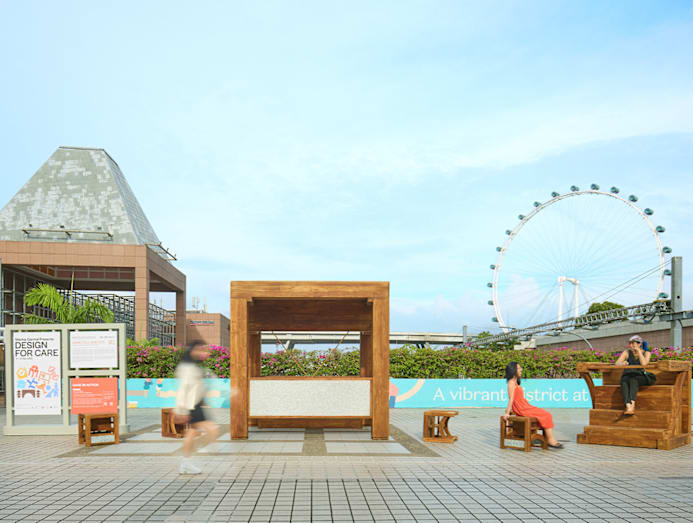
He cited Care-Full Shelter, an installation at the link bridge between Marina Square and Millenia Walk by art collective Vertical Submarine, as a particularly memorable example. Inspired by the traditional bamboo feeding chair, it was presented in three sizes, and as it got larger, more people could occupy it and have conversations.
“I felt it was very clever and fitted the theme,” he explained. “One day, as we were watching people responding to it, we overheard a three-generation family stop and talk about it. The mother told her children that she used to sit in the chair as a child. The narrative of care is also about personal stories. It was a very heartfelt moment.”
NOTHING WAS BY ACCIDENT
Even as he feels there is a need to be more overt in introducing care into the urban context, Chan pointed out that there are already attempts to do this in Singapore. For instance, tree planting provides shade against the tropical sun. In parks and gardens, benches are placed at approximately every 300m for visitors to sit and rest, and sheltered linkways extend up to 400m from train station entrances.
There is an entire legacy built around around it, established by our pioneers. “Singapore is a city by design,” he explained. “We needed to differentiate ourselves, according to our founding Prime Minister Lee Kuan Yew, who then set out the direction to build infrastructure such as water, housing and transport. Another way of looking at it is that it was designed with a purpose – we didn’t happen by accident; it was all part of the intrinsic value of caring about where we were going.”
What Chan hopes for is a more concerted effort towards greater attention to sustainability. By this, he means ensuring Singapore endures into the future, without overusing resources, especially by unnecessarily tearing down buildings to construct new ones in their place. For him, it is more than the negative environmental impact – it is also the destruction of heritage that it signifies.
“Can we look at adaptive reuse to say that it also has the unique proposition of being a social glue for a space and use this to inform urban planning? This should be part of a checklist. I would like us to have an environment that we can form long-lasting memories with yourself, your community and your family. Otherwise, everything ends up being preserved through images on a tote bag.”
It is clear that Chan has no shortage of ideas on how to substantiate his cause. He shared that the element of care has always been dominant in his practice as an architect and designer: “You know how when you cook char kway teow, you don't really care about the flavour. You just fry it and know how it will end up, but can't actually discern its parts – that is how it is for me.”
WALKING THE TALK
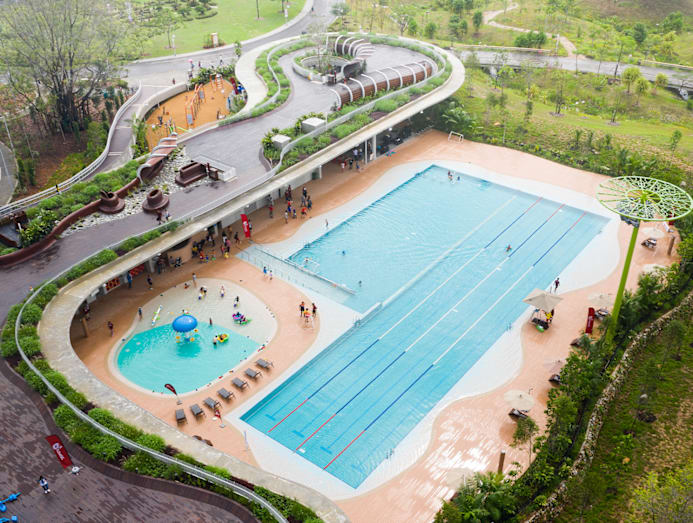
Chan has an entire portfolio of projects to validate his claims. ActiveSG Park @ Jurong Lake Gardens is a project where a public swimming pool is integrated into a park. In Singapore, these two facilities tend to be mutually exclusive, but Chan decided to turn the idea on its head.
To help the pool blend in more seamlessly with the park, he introduced a landscape feature called the ha-ha wall, a low-rise, recessed boundary. The result is that it looks ungated and has a natural appearance. “The care here is recognising how a recreation space can gel well with the design language of a park,” said Chan.
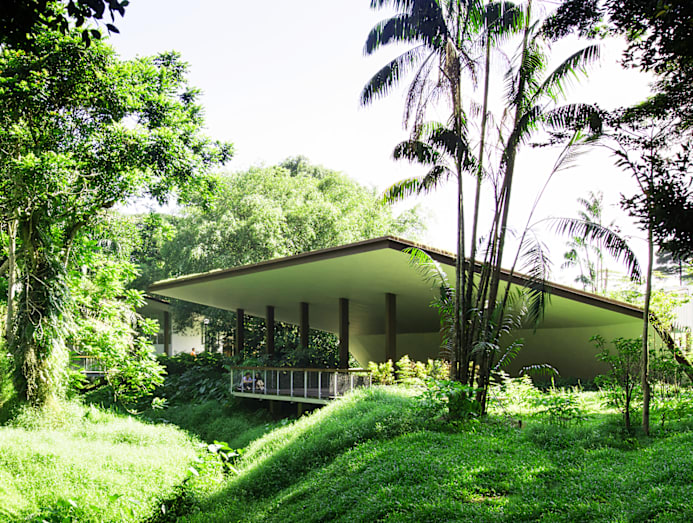
Windsor Nature Park is another project. Set within the Central Catchment Nature Reserve, it doubles as a regeneration zone for a secondary forest and is a placeholder until the authorities decide to convert the site for housing. Chan hopes that users will form a strong enough bond with it that when that time comes, there will be sufficient ground-up protests to prevent this from happening.
“This is a time-based strategy, where we intentionally build something and allow memories and communities to form. I call it a kind of quiet, assertive activism that protests in a subtle way.”
The third project he brought up hits close to home, being the development where the Zarch office is located. Chan was part of a year-long community engagement effort to champion the conservation of Golden Mile Complex. This came on the back of the “crazy en bloc fever” in 2018 that put it at risk of being demolished. “I felt that as a practitioner of the built environment, we had to rally support against it.”
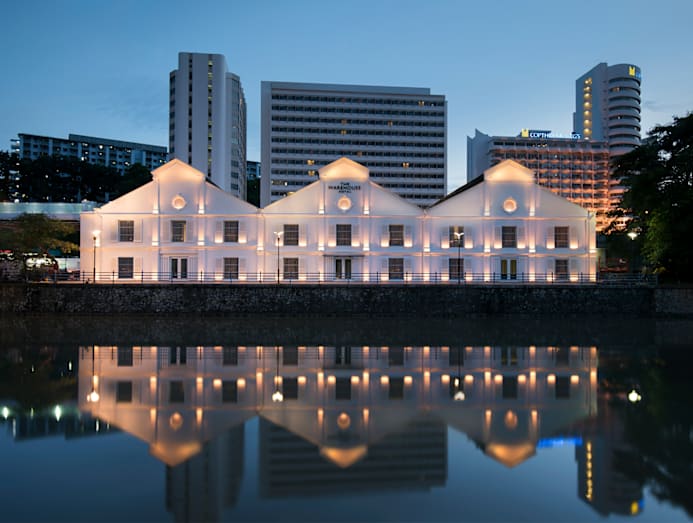
He certainly has the chops to do it, since conservation projects make up his portfolio. The most well-known is the Warehouse Hotel project, where the vision was to create an urban living room in Robertson Quay. “With that project, we brought the narrative in as part of the value system, and it became a brand for the project,” he reminisced.
Within the four walls of his office, Chan is equally adamant about building a practice with a heart. Challenging as business conditions are, he makes it a point to constantly remind his team about its importance. Simple gestures – greeting each other daily, taking breaks, and celebrating wins – have become priorities to promote mental wellness.
He reflected: “To me, what is most important is that those who cross paths with my office bring along this attribute with them. This is my little way of contributing to the discussion of care.”