How two-time GPHG winner Stefan Kudoke went from spray cans to skeletonised movements
From tagging walls to hand-finishing movements, Stefan Kudoke’s eclectic path mirrors the fearless individuality of his watches.
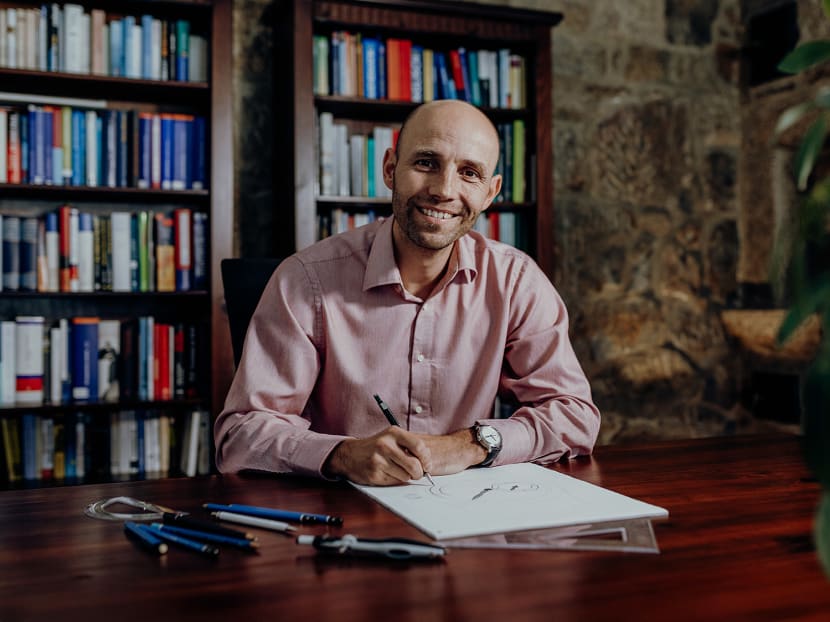
Stefan Kudoke. (Photo: Kudoke)

This audio is generated by an AI tool.


Big watch brands got big for a reason. Once upon a time they started to make something a lot of people liked, kept making them, and grew fat on R&D budgets and global marketing campaigns. Now they are perpetual machines that spit out the same impressive (if safe) crowd-pleasers year after year. This isn’t necessarily a bad thing, since owning a big-brand watch comes with cultural cachet and the comforting assurance that after-sales service isn’t like spinning a roulette wheel and hoping it lands on “yes, we have some measure of this”. But big brands can get a little formulaic.
That’s where independents win. They’re wild, unpredictable, and just obscure enough to provide the thrill of exclusivity. And unlike the conglomerates, independents can make something because they want to, not because you want it. So, if there’s one thing that embodies independent watchmaking, it’s freedom — and it was exactly this that led Stefan Kudoke, somewhat unexpectedly, into haute horlogerie.
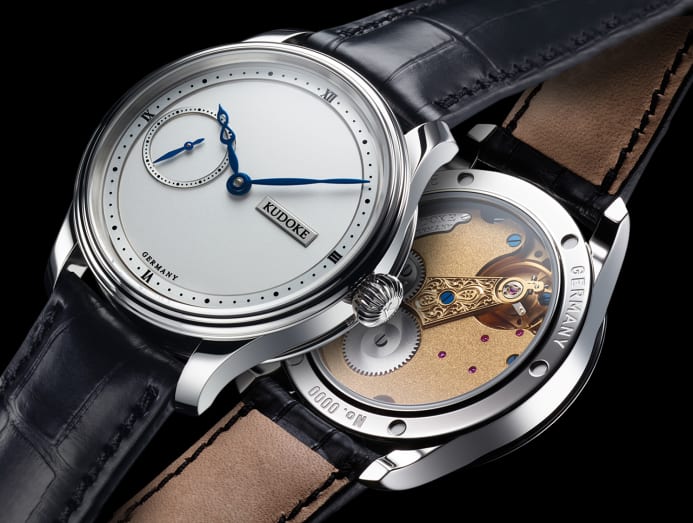
If you’re not already familiar, Kudoke is an independent German brand celebrating its 20th anniversary this year. Along the way, it picked up two Petite Aiguille prizes at the Grand Prix d’Horlogerie de Geneve (GPHG) in 2019 and 2024, which is awarded to watches retailing between CHF 3,000 (US$3,715; S$4,810) and CHF 10,000. Known for obsessive craftsmanship and often intricate skeletonisation and engraving, Kudoke offers exceptional value for the handwork poured into each piece. Not bad for a founder whose first artistic outlet was spraying graffiti in Frankfurt.
Stefan was just 12 when he started graffitiing, and by 17 he was running a side hustle doing airbrush art on cars and motorcycles. He was also a competitive cyclist, but eventually realised the long-term career prospects (and doping scandals) weren’t for him. “I asked myself, ‘What is my direction?’” he recalled.
It was his mother who pointed him in one — just across their house. “It was a watch restoration shop. She said I could be a watchmaker because it would be warm and dry there in the winter, there would be no stress, and my hands would always be clean.” Stefan applied for an apprenticeship, and a choice founded on pragmatism turned into a career built on passion.
At just 22, he earned his Master Craftsman certificate — one of the youngest ever to do so. “When you have a goal, you make a plan, train, and work hard to get it. That’s something I learned from sports,” he said. After stints at Glashutte Original, Breguet, Blancpain, and Omega, Stefan felt the itch to focus on traditional craft and hand-finishing — techniques he hadn’t learned in the big-brand world. So, he taught himself the old-fashioned, pre-Youtube way: Books, practice, and more practice. “When I get frustrated, I just put the watch down and go cycling,” he shrugged.
That do-it-yourself ethos has shaped how Kudoke operates. Unlike the assembly-line approach of larger brands, each watchmaker at Kudoke is responsible for the entire watch, from assembly to finishing, casing, and quality checks.
He also lets them manage themselves. “We have a meeting every Monday to set goals, and then the team self-organises,” shared Stefan’s wife and co-founder Ev, who oversees the non-creative side of the business. “We’re only human so not all days will be the same. Maybe you can’t complete the finishing on this day because you have a headache or your eyes are tired (“Or you’re hungover!” chimed in Stefan), you get someone else to take over and help. We’re not going to tell them they need to assemble 10 watches in a day. They can choose how to work.”
Finding the right people for such an egalitarian system isn’t easy, but when it works, it works. “I don’t want to stay in the workshop controlling them all the time,” Stefan said. One thing he has no patience for? Office politics. “In the past there would be people who would focus on career advancement instead of the product. I hated that.”
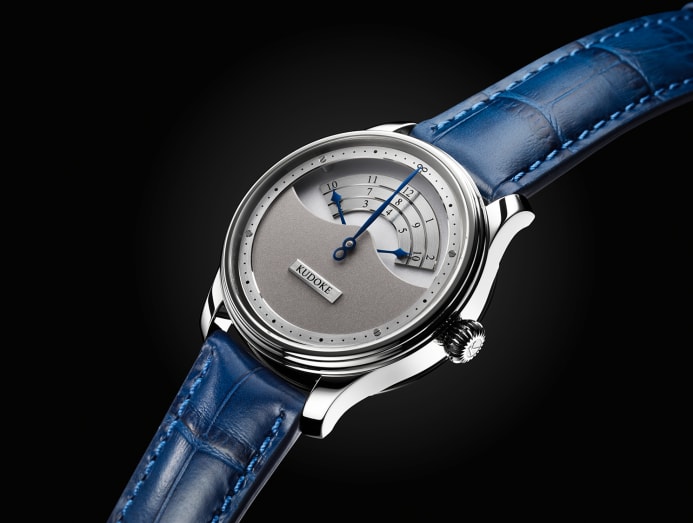
And when Stefan Kudoke focuses on a product, it shows. Kudoke started out making elaborate one-offs for clients, a spirit still alive in the Kunstwerk collection, where engraving and skeletonisation run riot. In 2019, the more restrained Handwerk line was launched, showcasing the brand’s first in-house movement, Kaliber 1, with an aesthetic that expressed Stefan’s individuality as well as the sensibilities of German watchmaking.
“German watches are minimalist in design, so we are quite reduced in our design language,” explainsed Ev. “The Swiss are much more playful, so we are a bit more traditional and conservative.” The flair comes, instead, from decoration. Stefan continued proudly: “Swiss movements don’t have so much engraving, but typical German ones have three-quarter plates with engraved balance cocks.”
The focus is now on Handwerk’s regular production models, though there is still room for personalisation. Clients can choose from a few dial and case options, as well as the degree of decoration for the movement: Part skeleton, fully relief engraved, or combined. “One thing we won’t do is unique dial colours,” noted Ev. “If we do that for every customer we won’t have any colours left for our collection.”
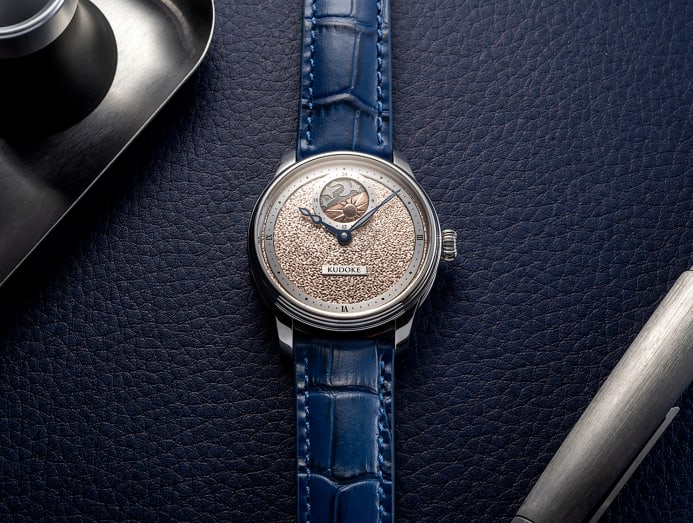
Exceptions have been made for special partners and occasions, though. Sincere Fine Watches, the exclusive distributor for Kudoke in Singapore and Malaysia, recently released a 20-piece limited Kudoke 2 SHH Edition to celebrate the watchmaker’s 20th anniversary. The model, which offers hours, minutes, and a beautifully engraved 24-hour day/night indicator at 12 o’clock, gets a “flakes” dial in a “champagne rose” hue. That crystalline texture is painstakingly carved out by hand, and then electroplated in silver and gold before getting a rose-tinted transparent lacquer coating. This flakes finishing was first seen in the Kudoke 3 Flakes, but this will be the first and last time this shimmering finish will appear in a Kudoke 2.
The one exception he won’t make is selling the first watch he made under his name. “It was so ugly!” he laughed. “It was a normal skeleton watch, but the engraving skills were not like what it is today. The finishing, the bevelling — not so nice. But I still have it in my office as a good memory of how we have developed.”
And after two GPHG wins, they certainly have grown. After the first GPHG win, overwhelming demand stretched their waitlists to two years. They had to hire more people and move out of their basement and into a proper facility to accommodate the expanded team. “The second win was a signal that this was not just luck. It was a result of doing something right.”
Unsurprisingly, the Kudokes have been inundated with offers from investors. They’ve turned them all down. “His strength is in being a watchmaker,” said Ev. “Once you have investors coming in, the makers become managers.”
And Stefan’s priority remains in preserving the hard-won knowledge that defines the brand. “We lost so much of it because of the Quartz Crisis,” he said. “Now that these skills are coming back, we have to make sure to save them. So, we document everything so that others will be able to learn how we do our hand-finishing long after we’re gone.”