A lump on the back that turned out to be TB
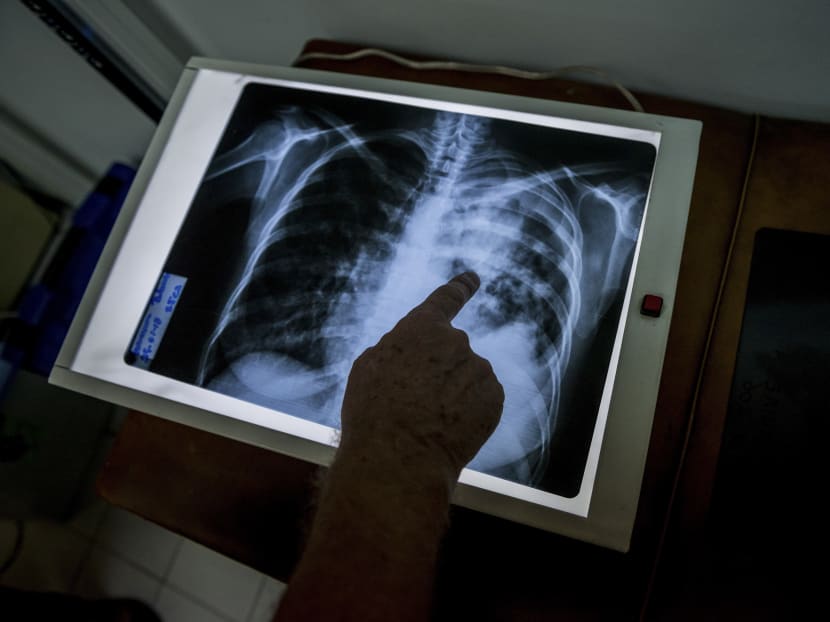
TB is endemic in Singapore and has made an appearance in several preschools here in recent years. Photo: New York Times
SINGAPORE — When Mr Dan Tay (not his real name) first noticed a 1cm lump on his toddler’s back last year, he thought she had injured herself and immediately took her to the KK Women’s and Children’s Hospital, where she underwent an MRI scan.
The 34-year-old engineer was taken aback to learn that the “bump” was due to tuberculosis (TB).
The infection had attacked his daughter’s spine instead of her lungs, which is usually the organ affected by TB.
How his daughter, who was two-and-a-half years old at the time, contracted the airborne infection remains a mystery.
Family members were screened and tested negative for TB. Mr Tay said that Tan Tock Seng Hospital’s TB Control Unit (TBCU) did contact tracing for the case but did not identify any positive cases at the childcare centre the toddler had been attending.
“To be honest, my wife and I are somewhat relieved that the lump is not a cancerous tumour. But we’re really confused about how she had contracted TB because no one else around her has it,” said Mr Tay, who wondered if his daughter could have contracted the disease when the family followed him overseas for work, or during their vacations.
He asked to remain anonymous as he is worried that his daughter, who is currently attending preschool, may be stigmatised. Now three, she is halfway through her nine-month-long TB treatment and not infectious.
WHEN TB SURFACES AT PRESCHOOLS
TB is endemic in Singapore and has made an appearance in several preschools here in recent years. Caused by the Mycobacterium tuberculosis bacterium, it is transmitted through respiratory droplets from an infected person.
While TB rates have dropped since highly efficacious treatment came along in the 1960s, the disease continues to be a global public health problem, said Dr Cynthia Chee, director of TBCU at Tan Tock Seng Hospital.
Children form a small proportion of TB cases seen here. Last year, 0.3 per cent of TB cases occurred in children below 10 years old, said the Ministry of Health (MOH).
Between 2015 and 2017, an average of 15 cases of TB involving both staff and children were reported in preschools or childcare centres each year. The number has remained largely consistent over the years, said the ministry.
The airborne infection is typically spread when there is close and prolonged exposure to a person with active TB, said Dr Chee.
Children at the highest risk of contracting TB are those living in the same household as someone with active TB, said Associate Professor Thoon Koh Cheng, head and senior consultant at the infectious disease service of KKH’s department of paediatrics.
Unlike the non-infectious, asymptomatic latent form of TB, people with active TB are usually infectious when they are coughing the TB bacteria out into the air.
“Individuals, including children, who are exposed to a person with active TB in the same household are likely to be continually exposed to the expelled air from the person, which contains hundreds of thousands of infectious TB particles. Their risk of breathing in these particles is therefore numerically higher than, say, another person who is exposed transiently on the streets,” said Assoc Prof Thoon.
Other children at risk include those who have had an organ transplant or are on medication that suppresses their immune systems.
Singaporeans who travel overseas are unlikely to acquire TB overseas unless they have such close and prolonged contact with an infectious individual, said MOH’s spokesperson.
MORE LIKELY TO AFFECT OTHER ORGANS
Children who get lung TB may experience symptoms like cough, lethargy, weight loss and/or fever, but symptoms vary depending on where the infection attacks. In children, there is a greater likelihood of the disease affecting other organs besides the lung such as the lymph nodes and, rarely, in the brain, bones, kidney and gastrointestinal tract, said Assoc Prof Thoon.
“This is partly because children’s immune systems are less able to confine the disease in the lungs, which is usually the first organ of entry,” he said.
If TB affects the brain, the child may get seizures and/or weakness or paralysis of the limbs. If it affects the bones, the child may develop pain, swelling in the affected area and may develop a limp, said Assoc Prof Thoon.
Among those who get infected, the majority develop latent TB, which is not uncommon here and may affect up to 30 per cent of older Singaporeans, said Dr Chee.
In healthy adults with the latent form, 5 per cent go on to develop active TB disease within the first two years and another 5 per cent may develop it sometime after two years and within their lifetime, said Dr Chee.
However, there is currently a lack of comprehensive data on the percentage of young children with latent TB who later develop its active form, she said.
“Some studies indicated that children under five have a higher risk of progressing to active TB, with those under two having the highest risk,” said Dr Chee.
Some health conditions can “awaken” dormant TB – for example, renal failure requiring dialysis, organ transplantation or when receiving medications that significantly weaken the body’s immune system, said Assoc Prof Thoon, adding that treatment of latent TB is possible with medication.
NO NEED TO CLOSE SCHOOLS WHEN ACTIVE TB CASE FOUND
In general, children with TB do not readily spread the disease to close contacts including people living in the same household, as paediatric forms of TB are generally less contagious, said Assoc Prof Thoon.
In addition, the patient becomes rapidly non-infectious once treatment starts, said Dr Chee, who added that a person cannot get TB from sharing cups, utensils and food, or from shaking hands and touching toilet seats.
“As a precaution however, the patient should not be exposed for prolonged periods of time to new close contacts within the first two weeks of treatment. They’re therefore put on medical leave immediately for two weeks once they start treatment,” she said.
There is “no need” to close schools or other places like workplaces where an active TB case has been found, said the MOH.
“Early detection and treatment through screening of close contacts can help prevent further spread of TB,” said its spokesperson.
Most of KKH’s patients make a full recovery, said Assoc Prof Thoon.
All children here receive the Bacillus Calmette-Guerin (BCG) vaccine as part of the National Childhood Immunisation Programme. However, the vaccine protects only against very serious forms of TB, such as TB meningitis (TB of the brain lining), said experts.
Even then, protection against brain TB is not 100 per cent, said Dr Leong Hoe Nam, an infectious diseases specialist at the Mount Elizabeth Novena Specialist Centre, who has seen and treated such cases here.
“While the BCG vaccination provides some protection against lung TB, such protection is incomplete and lung TB can still occur,” said Dr Chee.
The World Health Organisation does not recommend a booster shot for BCG as studies have failed to show its benefits.
Dr Leong said the risk for children contracting TB is proportionate to its prevalence in the community.
Early diagnosis and treatment is important but cases may be difficult to spot because the disease has a long incubation period ranging from weeks to decades, he said.
Mr Tay’s daughter’s condition was discovered before it caused further damage to her spine and she is currently wearing a protective brace. But the protracted treatment process has been challenging.
“Every morning at 6.30am, three people – my wife, myself and the helper – have to hold her down and force her to take her medication before her breakfast. She still cries every morning. Thankfully, we’re already more than halfway through her treatment,” he said.