Trusting Google delayed my treatment by nearly 3 months: A lesson in seeking professional medical advice
CNA Lifestyle’s Khoo Bee Khim lost sleep for six months over a lump-in-the-throat feeling that she thought was caused by post-nasal drip. After seeing a GP and two specialists, it might be something else altogether.
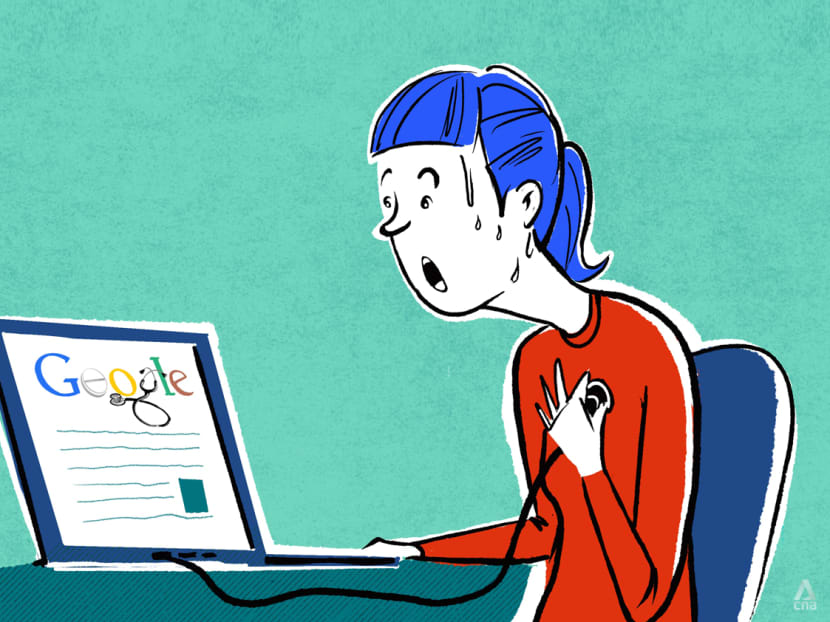
Think twice before you self-diagnose and self-medicate. (Art: Jasper Loh)


It was late last November when I finally got what many Singaporeans already had. No, not the CDC vouchers but COVID-19 for the first time. There were the typical symptoms: Sore throat, fatigue, fever, body aches and the sniffles. And true to what colleagues and friends had warned me about, the COVID-19 starter pack came with add-ons two weeks later, namely brain drain, memory lapses and a perpetual lack of energy.
Lots of coffee and some afternoon naps (I'm lucky to work from home, mostly) managed to help me function somewhat. What I didn’t expect was the perpetual sensation of phlegm at the back of my throat, which started to bother me right around January this year.
So I did what many people would do and consulted Dr Google, which described my experience as a post-nasal drip. In lay terms, that meant mucus (which I attributed to COVID-19) had been dripping from the back of the nose and accumulating inside the throat. It sounded about right because it felt like Vecna had me in a chokehold and no matter how hard I swallowed, there were still Stranger Things in there.
Off I went to the pharmacy for medicine to dislodge whatever it was in my pipe. Weeks went by. What started as a daytime inconvenience (constant throat clearing, coughing and eventual hoarseness) had now crept into the night. Between yet another cough and yet another need to clear my throat, I was fighting the constant reflex to swallow what felt like a gob of glue every minute.

The thing is, despite writing about health and wellness – and theoretically knowing better – I didn’t see a doctor. Not just yet. There was always something to do, something else that demanded my attention.
I didn't even bother with telemedicine. If I wanted the doctor to look down into my throat through a screen, I might as well request for an endoscopy (which, as I found out later, were famous last words that never rang truer).
The price I paid for my stubbornness? I was getting increasingly fatigued from the lack of sleep. My temper got shorter as my energy level dipped lower. I was not in a good place.
FINALLY SEEING A DOCTOR (OR THREE)
I finally saw a general practitioner in late March, almost three months since my phlegm fight began. And the first thing he asked upon hearing my story confused me. "How is your digestion? Sometimes, acid reflux can manifest as a lump-in-the-throat feeling,” he said.
“It’s my throat, not my gut. I don’t think I have digestion issues,” explained this Miss-Know-It-All, ready to whip out my handphone to show him what I'd Googled.
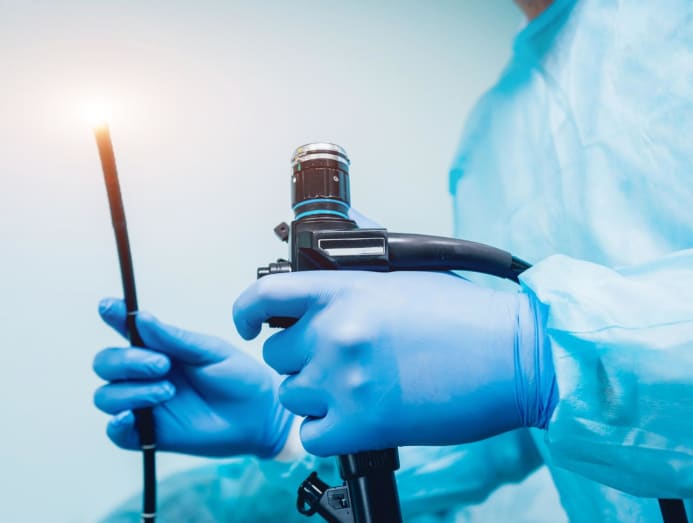
"Let's try some antibiotics for a start," said the GP as he wrote me a note to see an ear, nose and throat (ENT) specialist. “It’s not good since it’s been a while since your COVID-19 infection," he said. "Let’s get a scope done and see what’s causing the problem to be sure."
Long story short, by April, I'd already seen two ENT specialists, all within a month. The first one prescribed stronger antibiotics just to be on the safe side, even though both specialists did not find anything wrong with my nose and throat, at least COVID-19-wise.
The second specialist came to the same conclusion as the GP after hearing about my post-lunch naps. “It could be acid reflux. When you lie down, especially after eating, gastric acid escapes up your oesophagus, reaches your throat and irritates it. If that’s the case, the mucus is produced by your throat to protect itself against the acid and isn’t caused by post-nasal drip,” he said.
But was the lumpy feeling truly the result of acid reflux? “We'll do a process of elimination,” he said. “We’ll try to control your stomach acid situation and see if that improves your problem after six months. If it does, then it could well be acid reflux. Otherwise, we’ll reassess you.”

So there you have it: I’ve been on antacids and omeprazole (a proton pump inhibitor that reduces stomach acid levels) for almost two months now, and I’m glad to say that the coughing and hoarseness are gone. The pressing sensation has lessened enough to let me sleep through the night. But it’s still there.
DIAGNOSIS: COMPLACENCY
Losing sleep over a phlegmy throat sounds like the most ridiculous medical excuse. But what is even more absurd, on hindsight, was me thinking I could self-diagnose and self-medicate my way out of it. Writing about health is not the same as practising medicine.
As unpleasant and uncomfortable as my ordeal was, and still is, it isn't life threatening the way it turned out for some individuals who also sought to take matters into their own hands.
Dr Jonathan Tan, a family physician at Silver Cross Medical (Yishun), a member of Healthway Medical Group, has seen patients who mistook angina chest pains (caused by blocked coronary arteries) for plain ol’ muscle aches, and lung cancer for a cough that lasted six months.
He recalled a 40-something-year-old woman, who took over-the-counter (OTC) painkillers for her persistently painful wrist and fingers for years. She was convinced by Google that her symptoms were due to the repetitive use of the keyboard at work.
When she finally consulted Dr Tan, a blood test revealed that she had an autoimmune condition known as rheumatoid arthritis, which could potentially “cause other systemic problems such as damage to her lungs, hearts and other vital organs”.


DOCTOR-PHOBIC
Other than thinking they've got it under control, there are also other reasons why some people avoid doctors, said Dr Tan. One, they don’t wish to take medical leave. Two, they think that it is cheaper to get OTC medications for minor ailments such as coughs and colds, he said.
Then, there are those who genuinely believe the misinformation on social media. “For instance, at the height of the COVID-19 pandemic, there were multiple incidents of fake news purporting the alleged effectiveness of certain home remedies,” said Dr Tan. “There will be patients who sometimes believe and follow such misinformation rather than see a doctor.”
There are also the doctor-phobic, who believe that seeing a doctor meant blood taking and scans. “Ironically for some of them, it is these very medical tests that finally provide the answers to their ailments,” said Dr Tan.

WHAT NOW?
Whatever reasons you might have to avoid seeing a doctor, trust me, it's better if you do.
With a lump in my throat (both physically and emotionally), I now have to drink a chalky magnesium-based liquid three times a day and chew an acid-regulating tablet nightly. I also have to ensure that my social appointments end at least three hours before bedtime (yay). And certainly no napping – unless I snooze propped up in a chair (nay).
The lesson to be learned amidst the antacids and endoscopy: Don’t take health into your own hands, even if you think you know your body best. And also, Google is not your doctor.